
Research summary · moderate evidence · 5 min read
Down Syndrome and Sleep Apnea: Treatment Options from Tonsils to Nerve Stimulation
A guide for parents on testing and treating sleep apnea in children and teens with Down syndrome.
General information, not medical advice. Read our disclaimer.
CHILDREN · DOWN SYNDROME
Down syndrome and sleep apnea at a glance
- Up to 60%Of children with Down syndrome
- About halfStill have it after surgery
- 13+yearsU.S. approved age, nerve stimulator
- Sleep apnea is very common in children with Down syndrome.
- Removing the tonsils and adenoids is usually the first treatment.
- Many still have sleep apnea after surgery, so retest with a sleep study.
- A nerve implant cut breathing pauses by half in small teen studies.
- Studies are small and early, so long-term results are still coming.
Ask about a sleep study if your child…
- Snores, gasps or seems to stop breathing during sleep
- Sleeps sitting up or bent forward
- Is tired, cranky or has more behavior struggles in the day
- Had tonsil or adenoid surgery but still has symptoms
Sleep apnea is very common in children with Down syndrome. Removing the tonsils and adenoids is usually the first treatment. Surgery often improves breathing during sleep, but many children still have sleep apnea afterward.1 For teens and some younger children whose sleep apnea stays severe, an implanted device that moves the tongue forward during sleep has greatly reduced breathing pauses in small studies.23
Why is sleep apnea so common in Down syndrome?
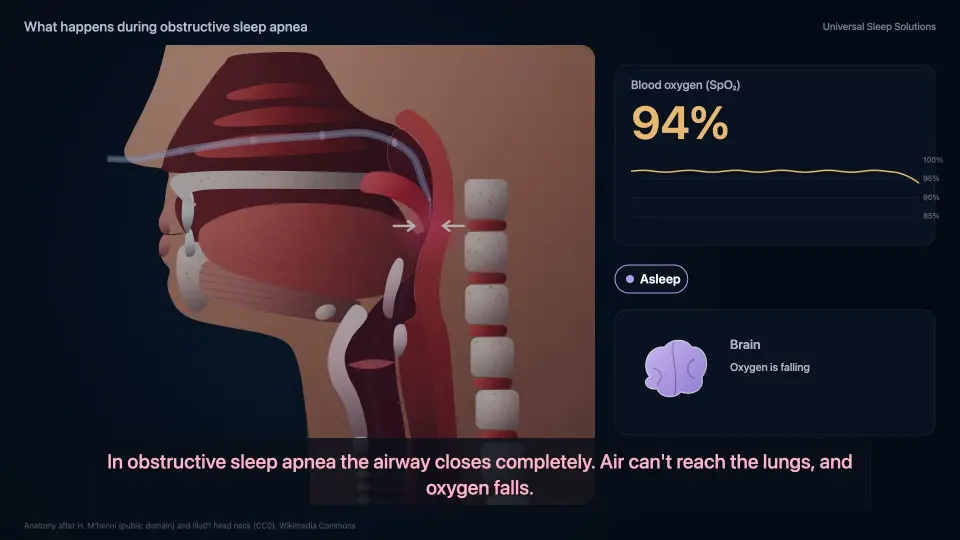
Obstructive sleep apnea (OSA) happens when the airway in the throat narrows or closes again and again during sleep. This causes pauses in breathing and broken sleep. Researchers estimate that sleep apnea affects up to 60% of children with Down syndrome.4
Doctors measure sleep apnea with an overnight sleep study. The key number is the AHI (apnea-hypopnea index). It is the average number of breathing pauses or shallow breaths per hour of sleep. In children, an AHI under 1 is generally considered normal.
Does removing the tonsils and adenoids help?
Often, yes, but it may not solve the whole problem. This surgery is called adenotonsillectomy. A review of the research found that it improved sleep apnea in children with Down syndrome, but many still had sleep apnea afterward.1 Sleep apnea may continue in about half of children with Down syndrome after tonsil and adenoid surgery.4
In the same report, one hospital's patients saw their median AHI fall from about 13.8 before surgery to 3.5 after.1
- Before surgery — only 10% of these children had an AHI under 5.
- After surgery — 60% had an AHI under 5, and 20% had an AHI under 1.1
The authors recommended surgery as a first-line treatment. But they noted that it may not be enough by itself.1 That is why a follow-up sleep study after surgery is so important for children with Down syndrome.
Is CPAP an option?
CPAP (continuous positive airway pressure) uses a small machine and mask to gently blow air that keeps the airway open. One small trial compared surgery with CPAP. It included children with Down syndrome or a related condition and mild to moderate sleep apnea.
A Cochrane review rated the evidence as low quality, but found the two may work about equally well.5 Some children do well with CPAP. Others with Down syndrome have a hard time wearing a mask every night.4
What is hypoglossal nerve stimulation?
Hypoglossal nerve stimulation is a small device placed under the skin during surgery. It senses breathing and sends a gentle signal to the nerve that controls the tongue. This moves the tongue forward to keep the airway open during sleep.4 One brand is called Inspire. It has been studied in children with Down syndrome whose sleep apnea stayed severe after tonsil surgery and who could not use CPAP.
- First group of teens — Six teens, ages 12 to 18, received the device, and it was well tolerated. Teens used it 5.6 to 10 hours a night. Their AHI dropped by 56% to 85%, and their quality-of-life scores improved.4
- Later review — It pooled 9 studies with 106 teens with Down syndrome. Every study showed the AHI dropping by at least half. On average, it fell by about 17 events per hour, and quality-of-life scores improved.2
- Side effects — The most common side effect was pain or discomfort in the tongue or mouth. Some patients needed their device settings adjusted.2
Can younger children get a nerve stimulator?
According to a 2025 study, U.S. approval for this device in Down syndrome covers ages 13 and up. That study followed 29 children ages 4 to 12 with Down syndrome and severe sleep apnea. They received the implant at two academic centers.
No serious problems occurred, and one minor wound issue healed with simple care. The median obstructive AHI fell from 18.4 to 3.9. Nearly all children with six-month results had their AHI cut by at least half.3
How strong is the evidence?
The results are encouraging but early. Most studies are small, follow children for a short time, and have no comparison group. There are no randomized trials yet.2 The researchers called for more study of long-term results, comfort, and side effects. They noted that a child's age should be weighed carefully.2 Families should know that this is a growing area, not a settled one.
When should your child get checked?
Sleep apnea is so common in Down syndrome that it is worth watching for. Ask your child's doctor about a sleep study if your child:
- Breathing at night — Snores, gasps, or seems to stop breathing during sleep
- Sleep position — Sleeps in unusual positions, such as sitting up or bent forward
- Daytime — Is tired, irritable, or has more behavior struggles during the day
- After surgery — Has had tonsil or adenoid surgery but still has symptoms
Even if symptoms improve after surgery, a repeat sleep study can show whether sleep apnea is really gone. It often persists in children with Down syndrome.1
How Universal Sleep Solutions can help
At Universal Sleep Solutions we see both children and adults. We offer in-lab sleep studies for children, with one parent staying overnight, which can be especially comforting for a child with Down syndrome. We coordinate with ear, nose, and throat (ENT) surgeons, set up and follow CPAP or BiPAP, and offer evaluation for Inspire when sleep apnea continues despite other treatment.
CHILDREN · AFTER SURGERY
One hospital's results after tonsil and adenoid surgery
| Before surgery | After surgery | |
|---|---|---|
| Median AHI (breathing pauses per hour) | About 13.8 | 3.5 |
| Children with AHI under 5 | 10% | 60% |
| Children with AHI under 1Deciding factor | Not given | 20% |
In children, an AHI under 1 is generally normal, so many still had some apnea.
Watch and learn
References
- Adenotonsillectomy outcomes in patients with Down syndrome and obstructive sleep apnea. The Laryngoscope, 2017. PMID 28055122 · doi:10.1002/lary.26398
- Hypoglossal nerve stimulation in adolescents with down syndrome and obstructive sleep apnea: A systematic review and meta-analysis. Frontiers in neurology, 2022. PMID 36388229 · doi:10.3389/fneur.2022.1037926
- Hypoglossal nerve stimulator for obstructive sleep apnea in children with down syndrome younger than 13. International journal of pediatric otorhinolaryngology, 2025. PMID 40714532 · doi:10.1016/j.ijporl.2025.112497
- Hypoglossal Nerve Stimulation in Adolescents With Down Syndrome and Obstructive Sleep Apnea. JAMA otolaryngology-- head & neck surgery, 2018. PMID 29098288 · doi:10.1001/jamaoto.2017.1871
- Tonsillectomy or adenotonsillectomy versus non-surgical management for obstructive sleep-disordered breathing in children. The Cochrane database of systematic reviews, 2015. PMID 26465274 · doi:10.1002/14651858.CD011165.pub2
Common questions
Will tonsil surgery cure sleep apnea in my child with Down syndrome?
What is the Inspire device?
Is nerve stimulation an option for children under 13?
What if my child will not wear a CPAP mask?
Trusted medical sources
This page follows guidance and research from leading medical organizations.
Further reading
- AAPSleep in Children
- Sleep FoundationChildren and Sleep
- Sleep FoundationHypoglossal Nerve Stimulation