Universal Sleep Solutions — sleep medicine and diagnostic sleep studies for every age

A sleep lab and clinic for infants, children, and adults — opening in Leander, Texas.

Chapter 01

Diagnose

Twelve channels.
One night. One picture.

  • One night, many signals — a sleep study records your brain, eyes, muscles, heart, breathing and oxygen.
  • All at the same time — every signal is recorded together, side by side.
  • More than “did you sleep?” — read together, they show how you slept.
Ask about a study
Live — polysomnography montage

A sample recording. Polysomnography is the medical name for a full overnight sleep study. It tracks brain waves (at least 3 channels), eye movement (2 channels) and the chin muscle. It also tracks heart rhythm, airflow, breathing belts and oxygen.

Where the sensors go

  • No pain — nothing hurts, and nothing goes through your skin.
  • Small sensors — they stick on with paste and tape.
  • Belts and a tube — soft belts go over your clothes. A thin, soft tube rests under your nose.
  • About 40 minutes — that is how long setup takes for most people.
Electrode placement

Reading the night back

  • 30 seconds at a time — each 30 seconds of your night gets a sleep stage.
  • A map of your night — put end to end, they make a chart called a hypnogram.
  • What it shows — how fast you fell asleep, how deep you slept and what woke you.
Hypnogram — one night

Also available

  • Split-night studies — testing in the first half of the night, treatment setup in the second, if you qualify.
  • Actigraphy — a wrist device that tracks sleep and wake at home for days or weeks.
  • Overnight oximetry — records your oxygen all night. It helps screen, but it does not diagnose.
  • Capnography — tracks carbon dioxide (CO₂) in your breath or through your skin. Key for children and nerve or muscle disease.
  • Extended EEG montage — extra brain-wave sensors when seizures at night are a concern.
  • Post-treatment studies — a repeat test after surgery, a mouth device or a big change in weight.

Common questions

What does polysomnography measure?
It measures brain waves, eye movement, muscle activity and heart rhythm. It also tracks breathing effort, airflow, blood oxygen, snoring and body position all night.
Which sleep study is more accurate?
An in-lab study measures more things. A home test is accurate enough to find moderate to severe sleep apnea in the right people.
What is the MSLT?
The Multiple Sleep Latency Test checks how fast you fall asleep during planned daytime naps. It is the main test for narcolepsy.

Chapter 02

Treat

Keeping the
airway open

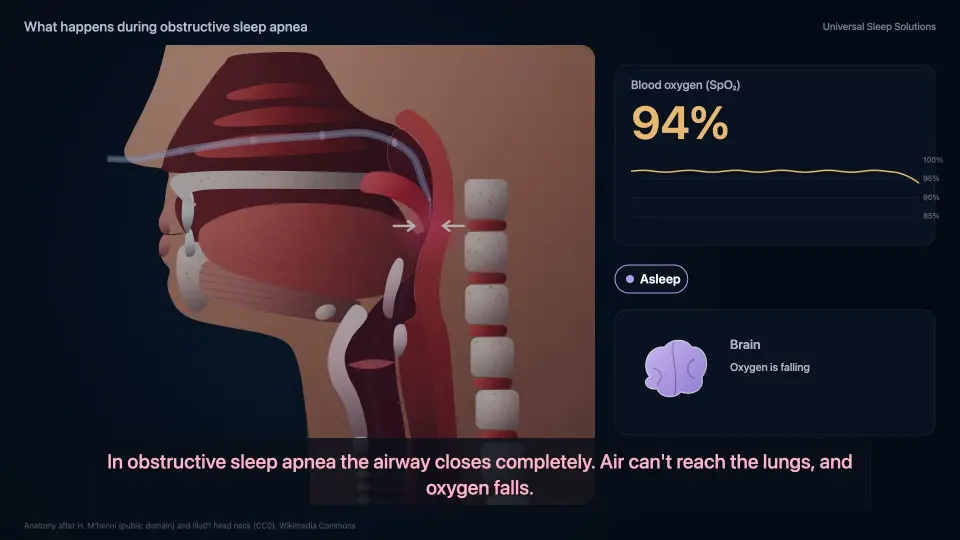
  • What goes wrong — in obstructive sleep apnea (OSA), your throat narrows and closes as you sleep.
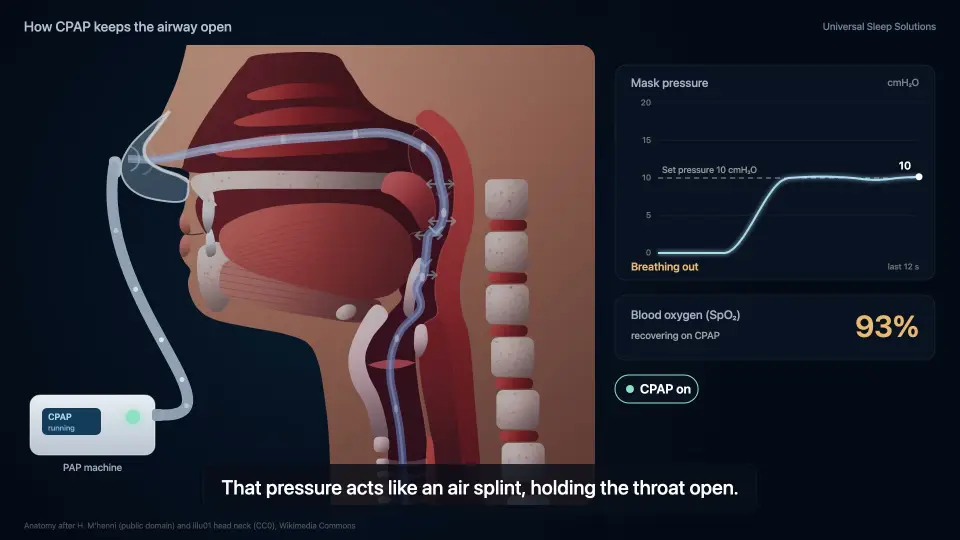
  • How PAP helps — positive airway pressure (PAP) gently blows a steady stream of air.
  • An air splint — that air holds your airway open, so your breathing keeps going.
Talk through options
Upper airway — collapse and PAP

A simple drawing. Each person's throat is shaped differently and closes in a different spot. That is one reason treatment is chosen for each person.

Watch: what happens, and how pressure treats it

What happens during obstructive sleep apnea 50 s · narrated and captioned
How CPAP keeps the airway open 36 s · narrated and captioned
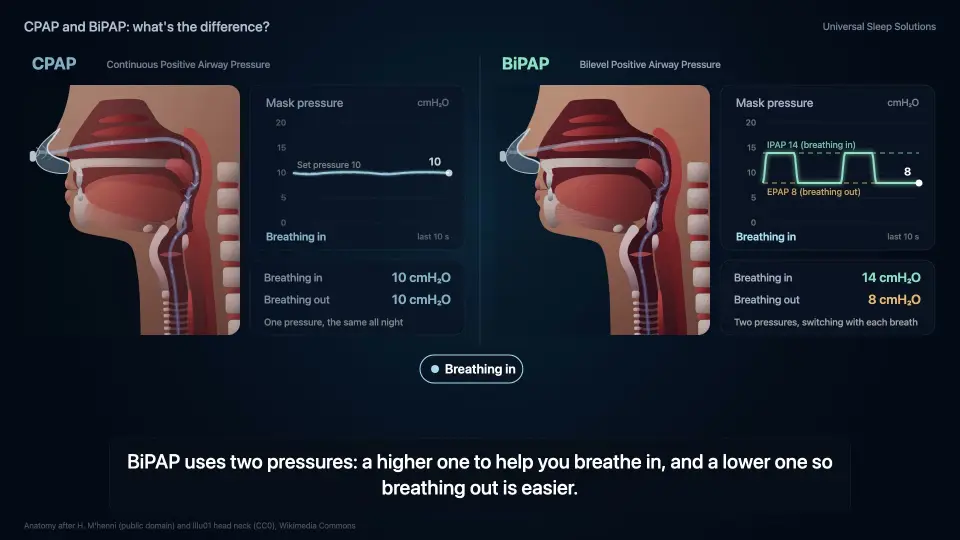
CPAP and BiPAP: what's the difference? 44 s · narrated and captioned

The pressures shown are examples, not prescriptions. Your settings come from your own study and follow-up visits.

A diagnosis is only the start. The work is finding the therapy a person will still be using in a year.

Minal Patel, M.D. — Universal Sleep Solutions

Managed alongside

  • Supplemental oxygen — added when your oxygen stays low, even with an open airway.
  • Adaptive servo-ventilation — a machine for some central apnea (the brain skips breaths) and complex apnea. Careful heart checks come first.
  • Nasal airway treatment — a stuffy or blocked nose is treated with ear, nose and throat (ENT) and allergy doctors.
  • Weight and metabolic health — a referral when weight plays a big part.
  • Surgical evaluation — a referral for tonsil, nose or airway surgery when needed.
  • Medication review — calming pills (sedatives), opioid pain pills and some antidepressants change sleep and breathing. They are worth a second look.

Common questions

Is BiPAP better than CPAP?
Neither is best for everyone. CPAP works well for most people with obstructive sleep apnea. BiPAP helps if you need higher pressure, have central sleep apnea or find it hard to breathe out.
Which CPAP mask is best?
The best mask is the one you will wear every night. Nasal pillows feel lightest, nasal masks seal well, and full-face masks suit mouth breathers.
What if I can't use CPAP?
We look at other choices that fit you. These include BiPAP, mouthpieces, sleep-position therapy, weight loss programs and surgery.

Chapter 03

Pediatrics

How much sleep
a child needs

  • Needs change fast — sleep needs shift more in childhood than at any other age.
  • Expert ranges — the American Academy of Sleep Medicine (AASM) lists hours of sleep by age.
  • Backed by pediatricians — the American Academy of Pediatrics (AAP) supports these ranges.
  • Check this first — it is a good guide before you decide your child just dislikes bedtime.
Refer a child
Recommended sleep by age

Ranges agreed by AASM experts and backed by the AAP. Hours for children include naps.

Children are scored differently

  • Its own field — children's sleep medicine is a specialty of its own.
  • AHI — the apnea-hypopnea index counts how often breathing stops or gets shallow each hour.
  • Lower cutoff for kids — 1 event an hour is too many for a child. For adults, it is 5.
  • Why — growing brains and bodies handle broken breathing far less well.
Pediatric AHI scale

Frequent reasons for referral

  • Habitual snoring — a child who snores most nights should be checked, not just reassured.
  • Witnessed pauses — breathing pauses a parent sees are one of the strongest reasons to test.
  • Mouth breathing — daytime mouth breathing that does not stop often comes with a blocked nose or big adenoids.
  • Bedwetting after dry nights — new bedwetting can come with breathing problems in sleep.
  • Morning headaches — waking with a headache can mean trouble moving oxygen and carbon dioxide at night.
  • Failure to thrive — poor growth plus poor sleep means breathing needs a closer look.

Common questions

Does my child need a sleep study before tonsil surgery for snoring?
The American Academy of Pediatrics advises a sleep study for children who snore and have other signs of sleep apnea. It shows how serious the problem is and helps you choose between surgery and other options.
Can sleep problems affect my child's behavior?
Yes. Tired children often seem overactive, act without thinking and have trouble paying attention, which can look like ADHD. Treating the sleep problem can greatly improve behavior.
Are night terrors harmful?
No. Children do not remember them, and they usually stop by the teen years. See a sleep specialist if they happen often or your child gets hurt.

Chapter 04

Adults

What a scored
event looks like

  • Apnea — your airflow almost fully stops.
  • Hypopnea — your airflow partly stops.
  • The pattern — air drops, oxygen falls a few seconds later, then you wake briefly to breathe.
  • Why it matters — when this repeats hundreds of times, your night stops being restful.
Book an evaluation
Airflow and oxygen saturation

A sample chart. The AHI (apnea-hypopnea index) counts these events in each hour of sleep.

Severity, by the numbers

  • Normal — fewer than 5 events an hour.
  • Mild — 5 to 15 events an hour.
  • Moderate — 15 to 30 events an hour.
  • Severe — 30 or more events an hour.
  • More than a number — your symptoms, oxygen levels and other health issues matter too.
Adult AHI scale

When the clock is the problem

  • Not always breathing — some sleep problems come from your body clock.
  • Your inner clock — melatonin, a sleep hormone, rises in the evening.
  • Body heat — your core temperature is lowest just before dawn.
  • Out of step — shift work, jet lag and a late body clock pull these rhythms away from your day.
Circadian rhythm

Also evaluated

  • Shift work disorder — plans for rotating and night shifts that fit the job you really have.
  • Delayed and advanced phase — timed light, timed melatonin and schedule work for clocks that run late or early.
  • Sleep and heart health — apnea is closely tied to high blood pressure, atrial fibrillation (an uneven heartbeat) and heart failure.
  • Sleep and metabolic disease — links run both ways with diabetes, obesity and metabolic syndrome.
  • Perioperative screening — a check before surgery when apnea raises the risk from anesthesia.
  • Commercial driver certification — tests and forms for DOT (Department of Transportation) and other safety-sensitive jobs.

Common questions

What is a normal AHI?
Fewer than 5 events an hour is normal. That means fewer than 5 apneas or hypopneas in each hour of sleep.
Can you have sleep apnea without snoring?
Yes, though it is less common. Tiredness, trouble sleeping or morning headaches may be the main signs instead.
What are circadian rhythm disorders?
They are problems where your body clock is out of step with the world around you. They make it hard to sleep at normal times.

Chapter 05

The Lab

A room that feels
less like a hospital

  • Your own room — a private room, a real bed and a bathroom you don't have to ask for.
  • Your own pillow — bring it if you want to.
  • Watched all night — a sleep tech watches your recording from a control room.
  • Quick fixes — if a sensor comes loose, it gets fixed before you lose data.
See what to expect
What the night looks like

Your night: the tech arrives at 8:30 pm, and you arrive at 8:45. Sensors are on by about 9:30. Lights go out between 9:30 and 10. You wake at 5 to 5:30 am. You go home by 6:00 am, when the tech leaves.

All agesBabies, children and adults tested in the same lab
AttendedA sleep tech is there, watching the whole recording
In-houseStudies scored here, then read by a board-certified doctor
One placeVisits, testing, treatment and follow-up under one roof

Common questions

Are sleep labs comfortable?
Today's sleep labs are built for comfort, with private rooms, regular beds and a homey feel. Most people find them more comfortable than they expected.
Are sleep study sensors painful?
No. The sensors sit on the surface of your skin with gentle glue or paste, and there are no needles.
Can I use the bathroom during a sleep study?
Yes. The tech will unhook you, then hook you back up when you are done.

Chapter 06

The Practice

Minal Patel, M.D.

  • Board-certified — in sleep medicine and in pediatrics (children's medicine).
  • Trained — pediatric residency and sleep medicine fellowship at the University of Mississippi Medical Center.
  • Taught there — she then served as Program Director of the Sleep Medicine Fellowship.
  • Professor — she was also Assistant Professor of Sleep Medicine there.
About Dr. Patel
How care moves through the practice

Sleep problems are family problems. The person in the bed is rarely the only one losing sleep over them.

Minal Patel, M.D.

Board-certified

Certified in sleep medicine and pediatrics, and an Inspire-certified provider.

Academic background

She once ran a sleep medicine fellowship program and was an assistant professor.

Pediatrician first

A sleep doctor trained in pediatrics reads a child's study differently.

Local and independent

An independent practice in Leander, also affiliated with Teddy Bear Pediatrics and Sleep Medicine.

Evidence-based

Care that follows expert guidelines, and we explain the reasons to you.

Reachable

Questions between visits go to the clinic, not to a call center in another state.

Common questions

What does a sleep doctor do?
A sleep doctor finds and treats sleep problems like sleep apnea, insomnia, narcolepsy and restless legs. Tools include sleep studies, CPAP machines and behavior therapy.
What type of doctor treats sleep disorders?
A sleep medicine specialist: a doctor with extra training and board certification in sleep medicine. They may first train in lung, brain and nerve, mental health or other fields.
What happens at a sleep doctor appointment?
Your doctor goes over your symptoms, sleep history, health problems and medicines. They may check your airway and suggest a sleep study.

Chapter 07

Referrals

Built for
referring providers

  • Ask your real question — send the question you want answered. It comes back answered.
  • Full report — the full scored data, the interpretation and a clear recommendation.
  • Direct line — for cases that need a conversation instead of a fax.
Send a referral
Referral pathway

Good reasons to refer

Common questions

Should heart patients be tested for sleep apnea?
Yes. The American Heart Association advises checking for sleep apnea in heart failure, atrial fibrillation, high blood pressure that resists medicine, and after a stroke.
Should you get a sleep study before an AF ablation?
If you snore, feel sleepy by day or have been told you stop breathing in sleep, ask about testing. Heart and sleep teams can decide together how to fit it in.
Will surgery be canceled if I might have sleep apnea?
Not necessarily. Each hospital and surgical team decides, which may mean extra monitoring, testing before surgery or other safety steps.

Chapter 08

Library

Read up before
you sleep on it

Our services, 20 guides and 71 articles on sleep apnea, sleep testing, CPAP, Inspire, insomnia and children's sleep — written for patients and families by a board-certified sleep physician.

Open the library

All 71 articles

Library

Chapter 09

Visit

Coming soon to
Leander, Texas

  • Opening soon — Universal Sleep Solutions is opening in northern Greater Austin.
  • Working with local doctors — we welcome referrals and teamwork with providers nearby.
  • Pre-register online — the easiest way to become a new patient. We will contact you to set up your visit.
  • Call the clinic — for questions or medical equipment (DME) orders.
Clinic
Universal Sleep Solutions, PLLC
15161 Ronald Reagan Blvd, Unit 409
Leander, TX 78641
New patients
Pre-register online
Hours
Monday–Friday, 8:30 AM–5:00 PM
Fax
(877) 569-2885, for referrals and records
QR code linking to universalsleepsolutions.com

Scan with your camera to visit the site, or tap to save our contact card.

Download contact card (.vcf)

Common questions

Do I need a referral?
A referral from your doctor helps, and many insurance plans require one. You are welcome to call and ask, and we will tell you what your plan needs.
What should I bring to a sleep study?
Bring what you normally sleep in, your usual medicines, toiletries and anything that helps you sleep. Your own pillow is fine. For a child, bring their bedtime routine along.
Can a parent stay overnight with a child?
Yes. A parent or guardian stays in the room with every child. That is how the rooms are set up.
Will I actually be able to sleep with all those sensors?
Most people sleep a bit less well than at home, and the study still works. Scoring rules allow for this, so 1 imperfect night is usually enough.
How long until I get results?
Your study is scored here, then read by a board-certified sleep doctor. Results go to you and your referring doctor, and we go over them with you.
Do you see adults, or only children?
Both. Dr. Patel is board-certified in sleep medicine and in pediatrics, and the lab is set up for people of every age.
Diagnose
  1. 01 Diagnose
  2. 02 Treat
  3. 03 Pediatrics
  4. 04 Adults
  5. 05 The Lab
  6. 06 The Practice
  7. 07 Referrals
  8. 08 Library
  9. 09 Visit

Keyboard: ↑ ↓ chapters · ← → pages