
Research summary · strong evidence · 5 min read
Snoring Kids and Big Tonsils: When Adenotonsillectomy Helps
What the best studies show about tonsil and adenoid surgery for children who snore or stop breathing in their sleep.
General information, not medical advice. Read our disclaimer.
CHILDREN · TONSIL SURGERY
Tonsil surgery for snoring kids at a glance
- 464Children in the CHAT trial
- 2.7%Serious surgery problems in PATS
- Large tonsils and adenoids are the most common thought cause.
- Surgery improved behavior, symptoms, sleep and quality of life.
- Surgery did not improve formal attention or thinking tests.
- Almost half of children who waited got better on their own.
Talk to your child's doctor if your child…
- Snores most nights, or you hear pauses, gasps or snorts
- Breathes through the mouth or sleeps in odd positions to breathe
- Is sleepy, cranky, hyperactive or has behavior trouble
- Still snores after tonsil or adenoid surgery
Some children snore or have sleep apnea because their tonsils and adenoids are too large. For many of them, removing these (an operation called adenotonsillectomy) helps. Large trials compared children who had surgery with children who waited. Those who had surgery had fewer symptoms, better behavior, better quality of life, and better sleep-study results.12 Surgery did not improve scores on formal attention and thinking tests. Also, some children get better on their own. So the choice is worth talking through with your child's doctors.3
What is sleep apnea in children?
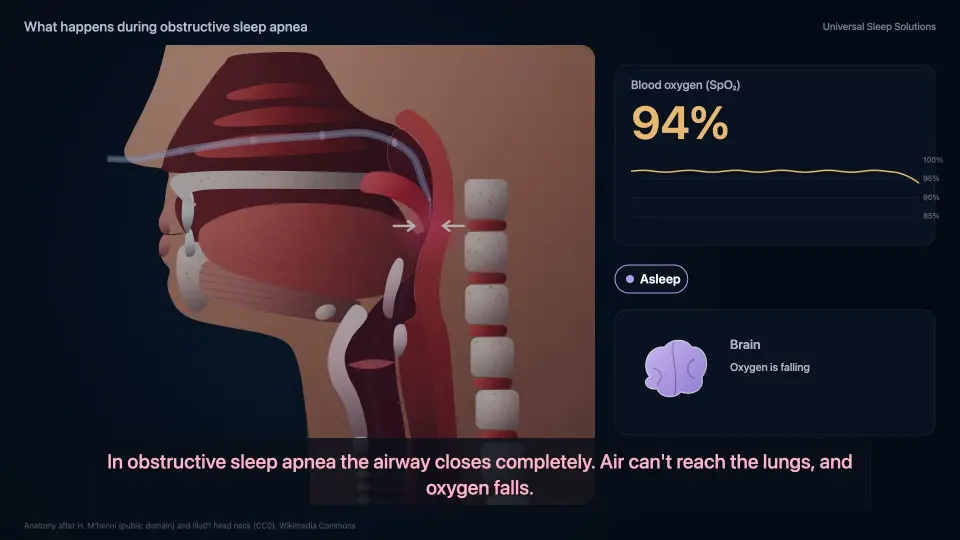
Obstructive sleep apnea (OSA) means the airway in the throat partly or fully closes again and again during sleep. Breathing gets shallow or stops for a few seconds, and sleep is broken up. Doctors measure it with an overnight sleep study (polysomnography).
The main number is the AHI (apnea-hypopnea index). This is the average number of breathing pauses or shallow breaths per hour of sleep.
Blocked breathing in sleep ranges from simple snoring to full sleep apnea. In children, large tonsils and adenoids (tissue at the back of the nose) are thought to be the most common cause.3 Because of this, the American Academy of Pediatrics advises that all children be checked for snoring. Children who snore and have other signs of sleep apnea should have a sleep study.4
What did the big studies of tonsil surgery find?
The American Academy of Pediatrics recommends adenotonsillectomy as the first treatment for children with sleep apnea and large tonsils.4 Two large trials tested it against waiting.
- CHAT — The Childhood Adenotonsillectomy Trial included 464 children with sleep apnea, ages 5 to 9. Chance decided who had early surgery and who had "watchful waiting" with supportive care. After seven months, children who had surgery had greater gains in behavior, quality of life, symptoms, and sleep-study results. Their sleep studies returned to normal more often: 79% compared with 46% of children who waited.1
- PATS — This trial looked at 459 children ages 3 to 12. These children snored but had only mild breathing problems (an AHI below 3). After 12 months, children who had surgery again had better behavior, less sleepiness, fewer symptoms, and better quality of life. Their blood pressure readings also went down more.2
- Worse breathing — In PATS, breathing got worse, to an AHI above 3, in only 1.3% of children who had surgery. This compared with 13.2% of children who waited.2
Does tonsil surgery help with attention and learning?
This is where the results are more modest. In both trials, children who had surgery did not score better than children who waited on the main tests of attention and executive function (planning and self-control skills).12 A Cochrane review carefully pools the best research. It rated this "no benefit" finding as high-quality evidence.3
That does not mean surgery has no effect on daily life. Parents in CHAT rated their children's behavior as better after surgery. But teachers' ratings did not differ between the groups.3 It is fair to expect better sleep, fewer symptoms, and possibly calmer days. It is not fair to expect surgery alone to raise test scores.
Can a child outgrow snoring or sleep apnea?
Sometimes, yes. In CHAT, almost half of the children who did not have surgery had normal sleep studies by seven months. This condition may get better over time. So the Cochrane authors said doctors and parents should weigh the benefits and risks of surgery against watchful waiting.3
They also noted that there is little trial evidence for children under age 5. Yet surgery is often done at that age.3
What are the risks of adenotonsillectomy?
All surgery carries some risk. In PATS, 2.7% of children had a serious problem related to surgery.2 In CHAT, serious problems happened in about 3% of the surgery group and 4% of the waiting group. This was not a meaningful difference.3
The children's guideline advises that children at higher risk stay in the hospital overnight after surgery to be watched.4
What if snoring continues after surgery?
Surgery does not fix sleep apnea for every child. The guideline recommends a follow-up visit after surgery. Children at higher risk, or who still have symptoms, should have another sleep test.4 If sleep apnea remains, or if surgery is not done, these options are recommended or advised:4
- CPAP (continuous positive airway pressure) — A small machine that gently blows air through a mask to keep the airway open. It is recommended.
- Weight loss — Advised for children who are overweight.
- Steroid nose sprays — May be an option for some children with mild sleep apnea.
When should your child be checked?
Talk with your child's doctor about a sleep checkup if your child:
- Snores — Snores most nights, or you hear pauses, gasps, or snorts during sleep.
- Breathes through the mouth — Or sleeps in odd positions to breathe.
- Struggles in the day — Is sleepy, cranky, hyperactive, or has trouble with behavior during the day.
- Snores after surgery — Still snores after tonsil or adenoid surgery.
A sleep study can show whether breathing is truly blocked during sleep and how serious it is. That helps you and your child's doctors decide between surgery, watchful waiting, or other treatment.4
At Universal Sleep Solutions we care for children as well as adults. We offer in-lab sleep studies for children. One parent stays overnight, so your child is not alone in a new place. If surgery may help, we work with an ear, nose, and throat (ENT) surgeon. If breathing problems continue afterward, we can test again. When needed, we can set up and follow CPAP.
CHILDREN · TONSIL SURGERY
Surgery or watchful waiting?
| Surgery | Watchful waiting | |
|---|---|---|
| Normal sleep study at 7 months | 79% | 46% |
| Behavior, symptoms, quality of lifeDeciding factor | Bigger gains | Smaller gains |
| Attention and thinking tests | No better than waiting | Same as surgery |
| Serious problems | About 3% | About 4% |
From the CHAT trial of 464 children ages 5 to 9.
Watch and learn
References
- A randomized trial of adenotonsillectomy for childhood sleep apnea. The New England journal of medicine, 2013. PMID 23692173 · doi:10.1056/NEJMoa1215881
- Adenotonsillectomy for Snoring and Mild Sleep Apnea in Children: A Randomized Clinical Trial. JAMA, 2023. PMID 38051326 · doi:10.1001/jama.2023.22114
- Tonsillectomy or adenotonsillectomy versus non-surgical management for obstructive sleep-disordered breathing in children. The Cochrane database of systematic reviews, 2015. PMID 26465274 · doi:10.1002/14651858.CD011165.pub2
- Diagnosis and management of childhood obstructive sleep apnea syndrome. Pediatrics, 2012. PMID 22926173 · doi:10.1542/peds.2012-1671
Common questions
Will removing my child's tonsils improve their grades or attention?
Does my child need a sleep study before tonsil surgery for snoring?
Is it OK to wait and see?
What happens if sleep apnea continues after surgery?
Trusted medical sources
This page follows guidance and research from leading medical organizations.
Further reading
- AAPSleep in Children
- Sleep FoundationChildren and Sleep
- NIHSleep Disorders
- AASMSleep Education
- CDCSleep Health
- AASMObstructive Sleep Apnea