
Article · 3 min read
Common CPAP Problems and How to Fix Them
CPAP can be challenging at first. Here are solutions to the most common issues from a sleep medicine specialist.
General information, not medical advice. Read our disclaimer.
CPAP · TROUBLESHOOTING
CPAP problems at a glance
- Nearly every CPAP problem has a solution.
- The right mask is often the key to CPAP success.
- A heated humidifier prevents most dryness issues.
- Other treatments exist if you truly can't tolerate CPAP.
Call your sleep team if…
- You have tried these fixes and still struggle with CPAP
- You feel bloated from swallowing air
- You keep taking the mask off during sleep
Most CPAP users run into at least one problem, and you are not alone. The good news is that nearly every CPAP problem has a simple fix. Here are the most common ones and what to try.
What if your mask is uncomfortable or leaks?
The right mask is often the key to CPAP success.
Mask discomfort or poor fit
- Try another style — Masks come as nasal, nasal pillow, or full-face.
- Adjust the straps — Make them snug but not too tight.
- Check the size — Make sure you have the right mask size.
- Replace worn parts — Swap out worn cushions and headgear.
Air leaks
- Check the cushion — Look for wear and replace it if needed.
- Fit it lying down — Lie down and readjust the mask before sleep.
- Match your sleep position — Think about a mask designed for the way you sleep.
- Use mask liners — They can improve the seal.
What if your nose or mouth gets dry?
Humidification (adding moisture to the air) prevents most dryness problems.
- Heated humidifier — Use it and adjust the humidity settings.
- Heated tube — It helps prevent condensation (water drops in the tube).
- Saline spray — Use a saltwater nose spray before bed.
- Full-face mask — Switch to one if breathing through your mouth is the issue.
What if the mask makes you feel closed in?
- Nasal pillow mask — This is the smallest, least intrusive option.
- Daytime practice — Wear the mask during the day while you watch TV.
- Relax — Use relaxation techniques and deep breathing.
- Ramp feature — Start the ramp setting at a very low pressure.
What if the machine is noisy?
- Tighten connections — Make sure they are all secure. Loose fittings cause whistling.
- Filters — Check and replace them.
- Placement — Put the machine on a stable, flat surface below bed level.
- Newer machines — Modern machines are very quiet. Think about an upgrade if yours is older.
What if you take the mask off in your sleep?
- Build the habit — Use CPAP every night.
- Fix comfort first — Deal with any comfort problems before anything else.
- Set an alarm — Use it as a reminder to put the mask back on.
- Secure fit — Think about a mask that stays on more firmly.
What if your stomach feels bloated?
Bloating can come from swallowing air, called aerophagia.
- Lower pressure — Ask your doctor about lowering the pressure slightly.
- BiPAP — Think about switching to BiPAP, which uses a lower pressure when you breathe out (lower expiratory pressure).
- Raise your head — Keep your head raised while you sleep.
- Eat earlier — Avoid eating late before bed.
When should you call your sleep team?
Don't give up. If you've tried these fixes and still struggle with CPAP, contact your sleep specialist. Work with your sleep team to find what works.
Options include pressure changes, different machines, or other treatments like Inspire therapy or oral appliances. These other treatments exist for people who truly can't use CPAP. As a sleep specialist, I work with patients daily to fix these issues and make sure they get the best possible therapy.
CPAP · TROUBLESHOOTING
Quick fixes for common CPAP problems
| Try this | |
|---|---|
| Mask discomfortDeciding factor | Try a different mask style or size |
| Air leaks | Lie down and readjust the mask; replace worn cushions |
| Dry nose or mouth | Adjust the heated humidifier; try saline spray |
| Feeling closed in | Try a nasal pillow mask, the smallest option |
| Noise | Make sure all connections are secure |
| Pulling the mask off | Fix comfort issues first; set an alarm |
| Bloating (swallowing air) | Ask your doctor about lowering the pressure |
Watch and learn
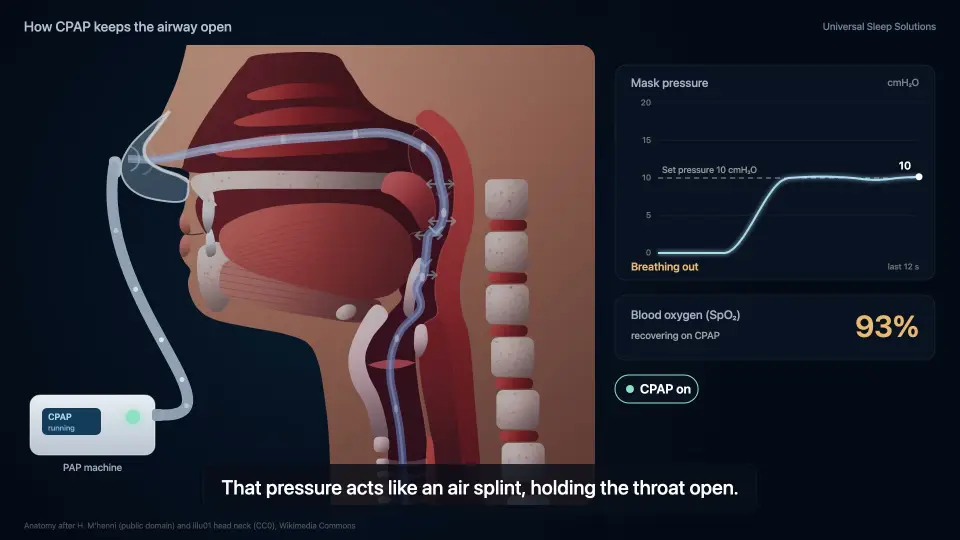
Common questions
Why does my CPAP mask leak?
Why do I get a dry mouth with CPAP?
Why do I feel bloated after using CPAP?
Trusted medical sources
This page follows guidance and research from leading medical organizations.
Further reading
- AASMCPAP Therapy
- Sleep FoundationCPAP Machines
- NHLBIPAP Therapy Overview
- AASMObstructive Sleep Apnea
- NHLBISleep Apnea Information
- Mayo ClinicOSA Overview