
Article · 3 min read
How CPAP Machines Work
A sleep specialist explains how CPAP machines work and how they keep your airway open while you sleep.
General information, not medical advice. Read our disclaimer.
CPAP · THE MACHINE
CPAP machines at a glance
- 4–20cm H2OUsual pressure range
- 6feetUsual tubing length
- 25–30dBSound, quieter than a whisper
- 3–5yearsTypical machine life
- CPAP uses air pressure like an invisible splint.
- Newer machines are quiet, with many comfort features.
- Auto-CPAP changes the pressure on its own through the night.
- Good care keeps treatment working and equipment lasting.
- Your sleep team can adjust your settings for comfort.
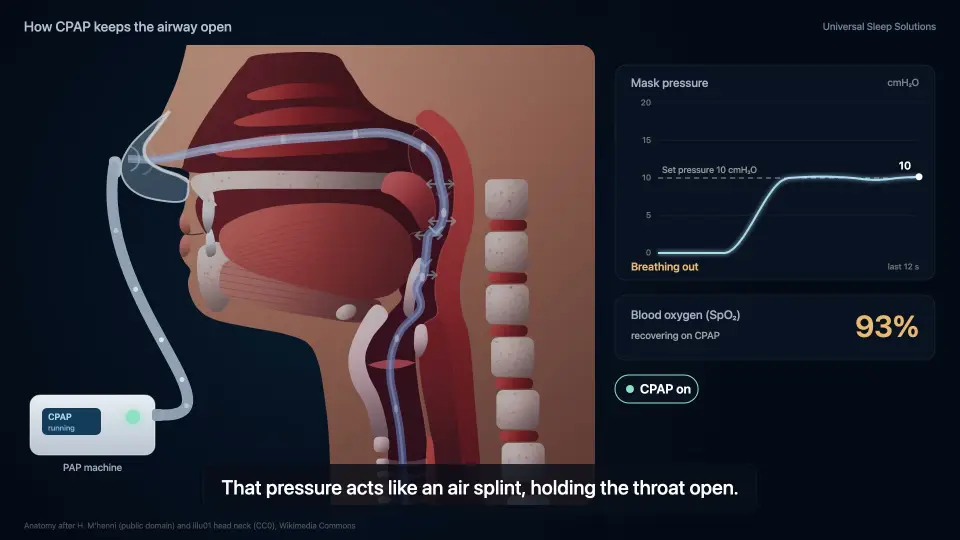
A CPAP machine pulls in room air and raises it to the pressure your doctor prescribed. That air flows through a hose and mask into your airway. The steady pressure holds your airway open while you sleep.
Why does it help to know how CPAP works?
CPAP machines may look complicated. But the idea behind them is simple. Knowing how your CPAP works can help you use it better. It can also help you fix common problems.
What are the main parts?
Every CPAP setup has four main parts that work together:
- Motor and blower — A small, quiet motor pulls in room air. It raises the air to the pressure your doctor prescribed.
- Heated humidifier — It warms the air and adds moisture. This keeps your nose from getting dry and sore.
- Tubing — A bendable hose, usually 6 feet long, carries the air from the machine to your mask. Heated tubing stops water drops from forming inside the hose (called rainout).
- Mask — It sends the air into your airway. Masks come in many styles.
How does air pressure keep your airway open?
Think of your airway as a soft, bendable tube. In sleep apnea, the walls of this tube fall inward. This blocks the air.
CPAP sends a steady flow of air under pressure. The air works like an invisible splint. It pushes the walls apart and keeps the airway open so you can breathe.
The pressure is measured in centimeters of water (cm H2O). It usually ranges from 4 to 20 cm H2O. Your setting depends on how severe your sleep apnea is.
What is the difference between fixed and auto-adjusting CPAP?
- Fixed CPAP — It gives one steady pressure all night. Your pressure is set during a titration study, an overnight test that finds the right pressure. It is simple and reliable.
- Auto-CPAP (APAP) — It uses built-in software to sense changes in your airway. It changes the pressure with each breath, all through the night. It uses a low pressure when your airway is stable. It raises the pressure when it senses apneas (pauses in breathing) or hypopneas (shallow breathing).
What smart features do newer machines have?
Newer machines are quiet and smart, with many comfort features. Your sleep team can help adjust your settings for comfort.
- Ramp — The machine starts at a low pressure. It slowly rises to your prescribed level. This makes it easier to fall asleep.
- Expiratory pressure relief (EPR) — The machine lowers the pressure a little when you breathe out. This makes it more comfortable.
- Data tracking — The machine records how many hours you use it. It also records your AHI (how many times per hour your breathing stops or gets shallow), mask leaks and more. Your sleep doctor can review this.
- Wireless connection — Many machines send your data to your care team by cell signal or Wi-Fi.
- Heated tubing — It stops water drops from forming inside the hose.
How do you take care of your CPAP?
Good care keeps your treatment working and helps your equipment last.
- Mask — Clean it every day with mild soap and water.
- Mask cushions — Replace them every 1-3 months.
- Tubing — Wash it every week.
- Humidifier — Use distilled water.
- Filters — Replace them as the maker suggests.
CPAP · THE PARTS
The main parts
| What it does | |
|---|---|
| Motor and blower | Pulls in room air and raises it to your prescribed pressure |
| Heated humidifier | Warms and moistens air so your nose stays comfortable |
| Tubing | Carries air to your mask; heated tubing stops water drops |
| Mask | Sends the air into your airway; many styles |
CPAP · MACHINE TYPES
Fixed CPAP vs auto-CPAP
| Fixed CPAP | Auto-CPAP (APAP) | |
|---|---|---|
| PressureDeciding factor | One steady pressure all night | Changes with each breath |
| How it is set | Set during a titration (pressure-finding) study | Built-in software senses your airway |
| When airway is stable | Same pressure | Uses a lower pressure |
| During breathing pauses | Same pressure | Raises the pressure |
Watch and learn
Common questions
How loud are modern CPAP machines?
Do CPAP machines need water?
How often should I replace my CPAP machine?
What is auto-CPAP?
Trusted medical sources
This page follows guidance and research from leading medical organizations.
Further reading
- AASMCPAP Therapy
- Sleep FoundationCPAP Machines
- NHLBIPAP Therapy Overview
- AASMObstructive Sleep Apnea
- NHLBISleep Apnea Information
- Mayo ClinicOSA Overview