
Research summary · mixed evidence · 5 min read
Sleep Apnea After a Heart Attack or Stent: What the Big Trials Really Show
An honest look at the SAVE, ISAACC and RICCADSA trials and what newer analyses say about CPAP after a heart attack or stent.
General information, not medical advice. Read our disclaimer.
HEART · CORONARY DISEASE
CPAP after a heart attack or stent
- About halfISAACC heart patients with sleep apnea
- About 3hoursAverage nightly CPAP use
- 4+hoursNightly use linked to benefit
- 31%Lower risk with good use
- Big trials did not show CPAP prevents heart attacks overall.
- Using CPAP 4+ hours nightly was linked to 31% lower risk.
- CPAP may help most in high-risk sleep apnea.
- These newer findings come from extra analyses and need confirmation.
- CPAP clearly reduced snoring and sleepiness and improved mood.
After a heart attack, stent or bypass, ask about testing if you have…
- Loud snoring or breathing pauses others notice
- Daytime sleepiness, tiredness, or low mood
- High blood pressure or an irregular heartbeat
- A CPAP machine you rarely use or find uncomfortable
Large trials found that simply prescribing CPAP to people with heart disease and sleep apnea did not prevent future heart attacks or strokes.1,2,3 But in those trials, people used CPAP only about three hours a night on average. Researchers then looked at people who used CPAP at least four hours a night, and at people with more severe oxygen drops. In these groups, CPAP appeared to lower the risk of new heart and stroke events.4,5
How common is sleep apnea after a heart attack or stent?
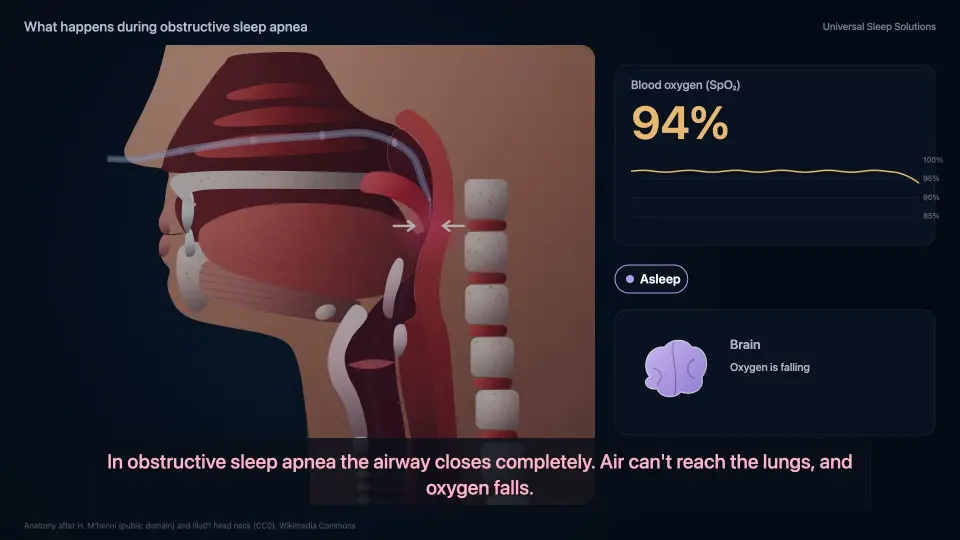
Obstructive sleep apnea (OSA) happens when the throat narrows or closes during sleep. This causes pauses in breathing and drops in oxygen. Doctors measure it with the apnea-hypopnea index (AHI). This is the number of pauses and shallow breaths per hour of sleep.
Sleep apnea is common in people with coronary artery disease (narrowed heart arteries). Many of them do not feel sleepy during the day.3 In the ISAACC study, about half of the people admitted to the hospital with a heart attack or unstable chest pain had sleep apnea on testing. Doctors call these problems acute coronary syndrome.2
Does CPAP prevent another heart attack?
CPAP (continuous positive airway pressure) is a bedside machine. It gently blows air through a mask to keep the airway open during sleep. Three major randomized trials tested whether it prevents heart problems:
- SAVE — This trial enrolled 2,717 adults with moderate to severe sleep apnea and heart or brain blood vessel disease. CPAP lowered the AHI from 29 to under 4. But after about 3.7 years, heart and stroke events were similar in both groups (17.0% with CPAP and 15.4% without). People used CPAP 3.3 hours a night on average.1
- ISAACC — This trial followed 1,264 people with sleep apnea who were not sleepy and had just had acute coronary syndrome. Events were similar with or without CPAP (16% versus 17%). Average CPAP use was about 2.8 hours a night.2
- RICCADSA — This trial studied 244 people with sleep apnea but no sleepiness. Each had just had a blocked heart artery opened. Over about five years, events were 18.1% with CPAP and 22.1% without. This difference was not statistically clear.3
So the honest answer is this. In these trials, prescribing CPAP to everyone did not prevent heart attacks, strokes, or heart deaths overall.1,2,3
Why might the big trials have missed a benefit?
One leading idea is that many people did not use CPAP long enough each night. In RICCADSA, some people used CPAP four or more hours a night. After adjusting for other health conditions, they had a much lower risk of events.3
A 2023 analysis combined the individual records of 4,186 people from all three trials. Overall, CPAP made no difference. But some people had good adherence, meaning they used it at least four hours a night. They had about a 31% lower risk of repeat heart and stroke events.4
A 2026 analysis of the same trials asked whether some kinds of sleep apnea matter more. It looked at "high-risk" sleep apnea. This means larger heart-rate jumps after breathing pauses, or a heavy "hypoxic burden." Hypoxic burden is the total amount of oxygen drop during the night.
CPAP seemed to help people with high-risk sleep apnea. In people with lower-risk sleep apnea, those on CPAP seemed to do worse. This may have canceled out the benefit in the overall results.5 Researchers hope this can help identify who is most likely to benefit.
How sure are these newer findings?
Not every finding points the same way. In ISAACC on its own, events did not seem to be related to how much people used CPAP.2
The pooled results above are after-the-fact analyses, not the trials' main results. So they need confirmation. People who use CPAP faithfully may also differ in other healthy ways. These results suggest, rather than prove, that good nightly use matters.
Is CPAP still worth it if you have heart disease?
For many people, yes. In SAVE, CPAP clearly reduced snoring and daytime sleepiness. It also improved mood and quality of life.1 Feeling more rested and alert matters, especially while you recover from a heart event.
If you use CPAP, aim for at least four hours every night, and ideally the whole night. This is a reasonable goal based on the evidence so far.4 CPAP does not replace heart medicines, cardiac rehab, or other care your heart team recommends.
How does Universal Sleep Solutions help?
At Universal Sleep Solutions we offer:
- Sleep testing — In-lab and home sleep testing.
- CPAP care — CPAP setup and close follow-up to help you reach comfortable nightly use.
- Other options — Evaluation for alternatives when CPAP does not work for you. These include an oral appliance referral or Inspire therapy.
We are glad to share results with your cardiologist.
When should you get checked for sleep apnea?
Ask about a sleep evaluation if you have had a heart attack, stent, or bypass surgery and you have:
- Breathing signs — Loud snoring or pauses in breathing that others notice.
- How you feel — Daytime sleepiness, fatigue, or low mood.
- Heart signs — High blood pressure or an irregular heartbeat.
- CPAP trouble — A CPAP machine you rarely use or find uncomfortable.
Testing may still be worth discussing even if you do not feel sleepy. Many people with heart disease and sleep apnea have no daytime sleepiness.3
HEART · THE BIG TRIALS
The three big CPAP heart trials
| SAVE | ISAACC | RICCADSA | |
|---|---|---|---|
| Who joined | 2,717 adults with heart or brain vessel disease | 1,264 people after acute coronary syndrome, not sleepy | 244 people after a blocked artery was opened |
| Average CPAP useDeciding factor | 3.3 hours a night | About 2.8 hours a night | Not stated |
| Follow-up | About 3.7 years | Not stated | About 5 years |
| Events: CPAP vs none | 17.0% vs 15.4% | 16% vs 17% | 18.1% vs 22.1% |
| Main result | No clear difference | No clear difference | Difference not statistically clear |
Events means new heart and stroke problems. Pooled analyses suggest good nightly use may matter.
Watch and learn
References
- CPAP for Prevention of Cardiovascular Events in Obstructive Sleep Apnea. The New England journal of medicine, 2016. PMID 27571048 · doi:10.1056/NEJMoa1606599
- Effect of obstructive sleep apnoea and its treatment with continuous positive airway pressure on the prevalence of cardiovascular events in patients with acute coronary syndrome (ISAACC study): a randomised controlled trial. The Lancet. Respiratory medicine, 2020. PMID 31839558 · doi:10.1016/S2213-2600(19)30271-1
- Effect of Positive Airway Pressure on Cardiovascular Outcomes in Coronary Artery Disease Patients with Nonsleepy Obstructive Sleep Apnea. The RICCADSA Randomized Controlled Trial. American journal of respiratory and critical care medicine, 2016. PMID 26914592 · doi:10.1164/rccm.201601-0088OC
- Adherence to CPAP Treatment and the Risk of Recurrent Cardiovascular Events: A Meta-Analysis. JAMA, 2023. PMID 37787793 · doi:10.1001/jama.2023.17465
- Cardiovascular benefit of continuous positive airway pressure according to high-risk obstructive sleep apnoea: a multi-trial analysis. European heart journal, 2026. PMID 40794640 · doi:10.1093/eurheartj/ehaf447
Common questions
Does CPAP prevent heart attacks?
How many hours a night should you use CPAP?
Why use CPAP if the big trials were negative?
Can you have sleep apnea without feeling sleepy?
Trusted medical sources
This page follows guidance and research from leading medical organizations.
Further reading
- AHASleep Apnea and Heart Disease
- NHLBISleep Apnea & Cardiovascular Risk
- AASMObstructive Sleep Apnea
- NHLBISleep Apnea Information
- Mayo ClinicOSA Overview
- NIHSleep Apnea