
Article · 2 min read
CPAP vs. BiPAP: Understanding the Difference
Both machines treat sleep apnea with air pressure, but they give it in different ways. Here is what you need to know.
General information, not medical advice. Read our disclaimer.
SLEEP APNEA · PAP MACHINES
CPAP vs. BiPAP at a glance
- 1 vs. 2Pressure levels
- 15cm H2OAbove this, BiPAP is often used
- Both machines push air through a mask to open your airway.
- CPAP gives one steady pressure all night.
- BiPAP gives higher pressure in and lower pressure out.
- CPAP is the usual first treatment for obstructive sleep apnea.
- Your sleep specialist will suggest the right machine for you.
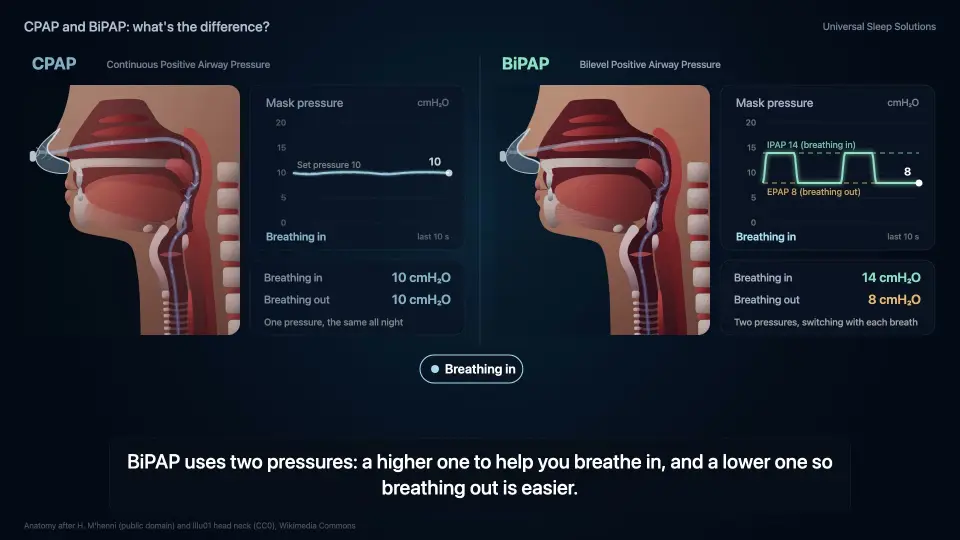
CPAP gives one steady air pressure all night. BiPAP gives two pressures: a higher one when you breathe in and a lower one when you breathe out. CPAP is the first treatment for most obstructive sleep apnea, and BiPAP helps in harder cases.
What do CPAP and BiPAP have in common?
CPAP and BiPAP are both positive airway pressure (PAP) machines. They push air through a mask to treat sleep apnea. They have the same goal: to keep your airway open while you sleep. But they give air pressure in different ways.
How does CPAP work?
CPAP stands for Continuous Positive Airway Pressure. It gives one steady pressure all night. The pressure stays the same when you breathe in and when you breathe out. This steady pressure works like a splint that holds your airway open.
How does BiPAP work?
BiPAP stands for Bilevel Positive Airway Pressure. It gives two different pressures:
- IPAP (Inspiratory Positive Airway Pressure) — A higher pressure when you breathe in.
- EPAP (Expiratory Positive Airway Pressure) — A lower pressure when you breathe out.
Having two pressures makes it easier to breathe out. This helps most if you need high pressures. It also helps if you find it hard to breathe out against a steady pressure.
When is BiPAP used?
- High pressures — People who need high CPAP pressures (usually above 15 cm H2O, the unit used to measure the pressure)
- Central sleep apnea — When your brain does not send the signal to breathe
- Complex sleep apnea — A mix of blocked-airway and brain-signal problems
- Lung problems — People with COPD (a long-term lung disease) or other breathing problems
- Heart failure — People with heart failure
- Trouble breathing out — People who cannot get used to breathing out against CPAP pressure
- Obesity hypoventilation syndrome — In this condition, extra weight makes you breathe too shallowly.
How do CPAP and BiPAP compare?
- Pressure — CPAP has one level. BiPAP has two levels.
- Comfort when breathing out — BiPAP is usually more comfortable at high pressures.
- Cost — CPAP costs less.
- Settings — BiPAP has more settings to adjust.
- First choice for obstructive sleep apnea — CPAP is the usual first treatment.
BiPAP is the better choice for complex cases, high pressures and some health problems. Your sleep specialist will suggest the right machine for your needs.
SLEEP APNEA · PAP MACHINES
CPAP and BiPAP side by side
| CPAP | BiPAP | |
|---|---|---|
| Pressure | One steady level | Two levels: higher in, lower out |
| Breathing out | Against the same pressure | Easier, more comfortable at high pressures |
| Cost | Costs less | Usually costs more |
| Settings | Fewer settings | More settings to adjust |
| Usual useDeciding factor | First treatment for most obstructive sleep apnea | Complex cases, high pressures, some health problems |
Watch and learn
Common questions
Is BiPAP better than CPAP?
Does BiPAP cost more than CPAP?
Can I switch from CPAP to BiPAP?
Trusted medical sources
This page follows guidance and research from leading medical organizations.
Further reading
- AASMCPAP Therapy
- Sleep FoundationCPAP Machines
- NHLBIPAP Therapy Overview
- AASMObstructive Sleep Apnea
- NHLBISleep Apnea Information
- Mayo ClinicOSA Overview
Part of our sleep apnea management service.