
Article · 2 min read
Surgical Treatments for Sleep Apnea
When CPAP or a mouth guard isn't enough, surgery may help. Learn about UPPP, jaw surgery, and other sleep apnea operations.
General information, not medical advice. Read our disclaimer.
TREATMENT · SURGERY
Sleep apnea surgery at a glance
- Surgery is usually considered after simpler treatments have not worked.
- Surgery fixes the body parts that block your airway.
- Candidates have a clear physical cause of the blockage.
- MMA is among the most effective surgeries.
- A full checkup helps find the best type for you.
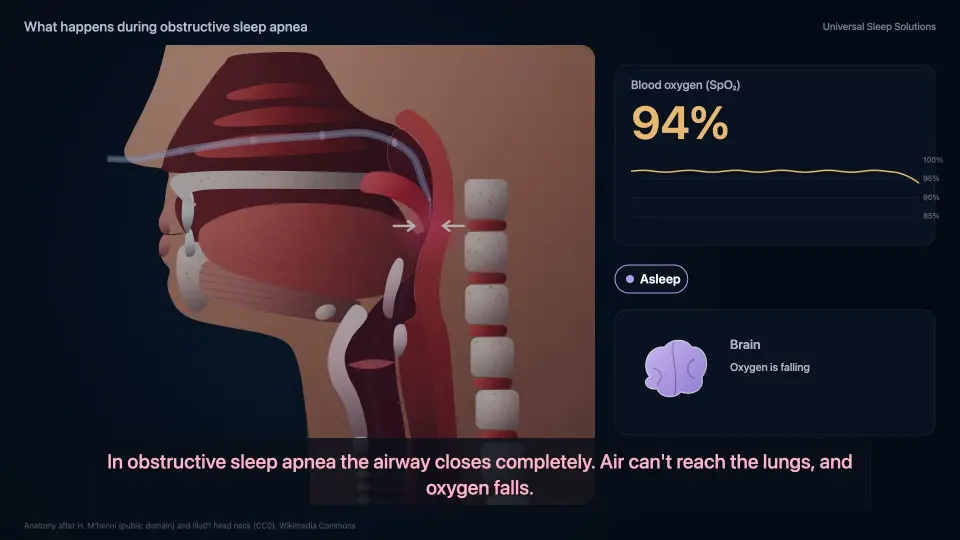
Surgery treats obstructive sleep apnea by fixing the body parts that block your airway. It is usually considered after simpler treatments, like CPAP or an oral appliance, have not worked. There are many types, and a full checkup helps find the best one for you.
When is surgery an option?
Many people try CPAP or an oral appliance first. CPAP is a machine that blows air through a mask to keep your airway open. An oral appliance is a custom mouth guard. If these do not work, or you cannot get used to them, surgery may help.
What types of surgery are there?
- UPPP (uvulopalatopharyngoplasty) — Removes extra tissue from the soft palate (the soft back part of the roof of your mouth) and throat.
- MMA (maxillomandibular advancement) — Moves both your upper and lower jaws forward. This makes the airway bigger. It is one of the most effective types of surgery.
- Tongue reduction surgery — Makes the base of the tongue smaller.
- Nasal surgery — Fixes a deviated septum (a crooked wall inside the nose) or enlarged turbinates (swollen ridges inside the nose). This helps you breathe through your nose.
- Tonsillectomy/adenoidectomy — Takes out the tonsils and adenoids (glands at the back of the throat and nose). It works especially well in children with sleep apnea.
- Inspire therapy — A small device placed in the body that stimulates a nerve. It is a minimally invasive surgery (done through small cuts).
Who is a good candidate for surgery?
- CPAP or mouth guard trouble — People who cannot get used to CPAP or oral appliances.
- A clear cause — People with a clear physical cause of the blockage.
- Ready for surgery — People who are willing to have surgery and go through recovery.
A full checkup helps find the best type of surgery for you.
Watch and learn
Common questions
When is surgery recommended for sleep apnea?
What is UPPP surgery?
Trusted medical sources
This page follows guidance and research from leading medical organizations.
Further reading
- AASMObstructive Sleep Apnea
- NHLBISleep Apnea Information
- Mayo ClinicOSA Overview
- NIHSleep Apnea
- AASMObstructive Sleep Apnea
- NHLBISleep Apnea Treatment
Part of our sleep apnea management service.