
Article · 2 min read
How Inspire Therapy Works
A close look at how Inspire works. Inspire is a device placed inside your body that treats sleep apnea without a mask.
General information, not medical advice. Read our disclaimer.
INSPIRE · HOW IT WORKS
How Inspire works at a glance
- 79%Average drop in AHI
- 90+%Long-term patient satisfaction
- 30minUsual delay before it starts
- Inspire keeps your airway open from the inside, with no mask.
- It signals the nerve that moves your tongue (hypoglossal nerve).
- It works in time with your own breathing.
- You turn it on and off with a small remote.
- Most people get used to the gentle tingle in a few nights.
Inspire is a small device placed inside your body that treats sleep apnea without a mask. It sends mild signals to the nerve that moves your tongue. This keeps your tongue forward so your airway stays open, in time with your breathing.
How is Inspire different from CPAP?
Inspire therapy is a big change in how sleep apnea can be treated. CPAP pushes air into your airway through a mask. Inspire works differently. It works with your own body to keep your airway from closing, from the inside.
Why does the tongue nerve matter?
The key to Inspire is the hypoglossal nerve. This is the nerve that controls the muscles of your tongue.
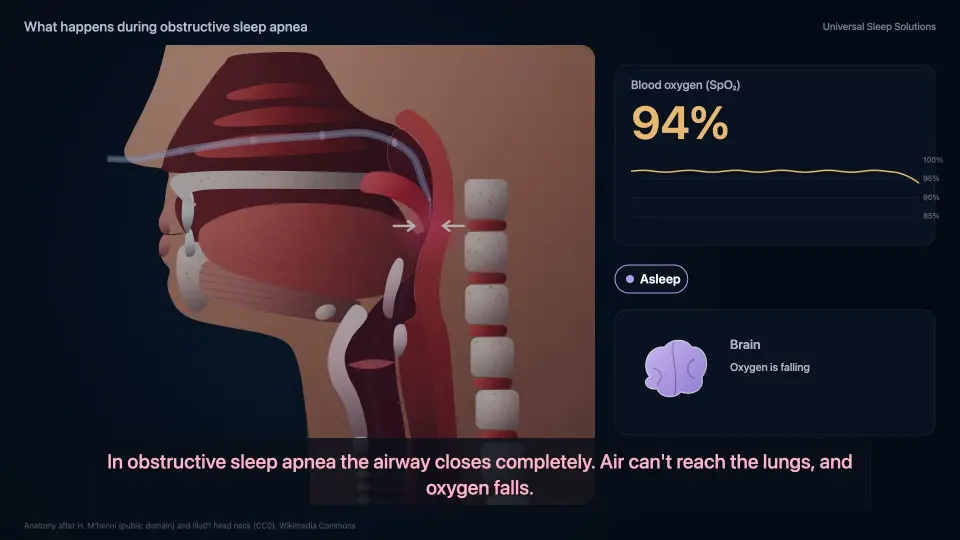
In obstructive sleep apnea, your tongue and the tissues around it relax during sleep. They fall backward and block your airway. Inspire gently sends signals to this nerve. This keeps your tongue forward so your airway stays open.
What are the parts of Inspire?
Three parts work together:
- Breathing sensor wire — It is placed between the muscles of your ribs. It senses each breath as it happens.
- Stimulation wire — It wraps around a branch of the hypoglossal nerve. It sends mild electrical pulses.
- Implantable pulse generator (IPG) — This is the "brain" of the system. It is placed in your upper chest. It matches the nerve signals to your breathing.
What happens while you sleep?
- You turn on the device with a simple handheld remote before bed.
- A delay gives you time to fall asleep. It can be set for you and is usually 30 minutes.
- The breathing sensor senses each time you breathe in.
- In time with your breathing, the IPG sends a mild signal to the hypoglossal nerve.
- Your tongue and nearby muscles gently move forward. This opens your airway.
- You breathe freely through the night.
What do studies show?
Studies show large drops in AHI and symptoms with Inspire therapy:
- Fewer breathing pauses — It lowers AHI by about 79% on average. AHI is how many times per hour your breathing stops or gets shallow.
- Better oxygen — It greatly cuts down on drops in blood oxygen.
- Less sleepiness — It improves scores for daytime sleepiness.
- Happy patients — Patient satisfaction is very high over the long term (over 90%).
INSPIRE · HOW IT WORKS
What happens while you sleep
Turn it on
Use the remote; a delay lets you fall asleep.
Sensor feels breath
The sensor notices each time you breathe in.
Signal to nerve
A mild signal goes to the tongue nerve.
Airway opens
Your tongue moves forward so you breathe freely.
Key point
INSPIRE · THE DEVICE
The three parts of Inspire
| Where it goes | What it does | |
|---|---|---|
| Breathing sensor wire | Between the muscles of your ribs | Senses each breath |
| Stimulation wire | Around a branch of the tongue nerve | Sends mild electrical pulses |
| Pulse generator (IPG) | Upper chest | Matches nerve signals to your breathing |
Watch and learn
Common questions
Can you feel Inspire working?
Do you use Inspire every night?
Can Inspire be removed?
Trusted medical sources
This page follows guidance and research from leading medical organizations.
Further reading
- Sleep FoundationHypoglossal Nerve Stimulation
- AASMObstructive Sleep Apnea
- NHLBISleep Apnea Information
- Mayo ClinicOSA Overview
- NIHSleep Apnea
- AASMObstructive Sleep Apnea