
Research summary · mixed evidence · 5 min read
Atrial Fibrillation and Sleep Apnea: Can CPAP Help Keep Your Heart in Rhythm?
A plain-language look at whether treating sleep apnea with CPAP helps keep atrial fibrillation from coming back.
General information, not medical advice. Read our disclaimer.
HEART · ATRIAL FIBRILLATION
AF and sleep apnea at a glance
- 25%AF returned with CPAP
- 42%AF returned without CPAP
- 57%AF returned, both trial groups
- Sleep apnea is linked to a higher risk of AF.
- Observational studies found AF came back less often with CPAP.
- The one randomized trial found CPAP added no extra benefit.
- CPAP reduced snoring and sleepiness and improved mood.
- Sleep apnea care works alongside your AF medicines and procedures.
See a sleep doctor if you have AF and…
- Loud snoring, gasping, or breathing pauses others notice
- Daytime sleepiness, morning headaches, or trouble focusing
- High blood pressure that is hard to control
- You plan an ablation, or AF came back after one
- You were told you might have sleep apnea but never tested
CPAP may help some people with atrial fibrillation, but the proof is mixed. Many studies followed patients after an ablation procedure. They found that AF came back less often in people who used CPAP.1,2 However, the one randomized trial that used heart monitors placed in the body found no added benefit. CPAP did not lower the return of AF any further after ablation.3
What is atrial fibrillation?
Atrial fibrillation (AF or AFib) is an uneven, often fast heart rhythm. It starts in the upper chambers of the heart. It can cause a fluttering or racing heartbeat, tiredness, or shortness of breath. Some people feel nothing at all.
Treatments include medicines and a procedure called catheter ablation. In this procedure, a doctor puts a thin tube inside the heart. The doctor uses it to scar small areas that trigger the uneven rhythm. A common type of ablation is called pulmonary vein isolation.
How are sleep apnea and AF connected?
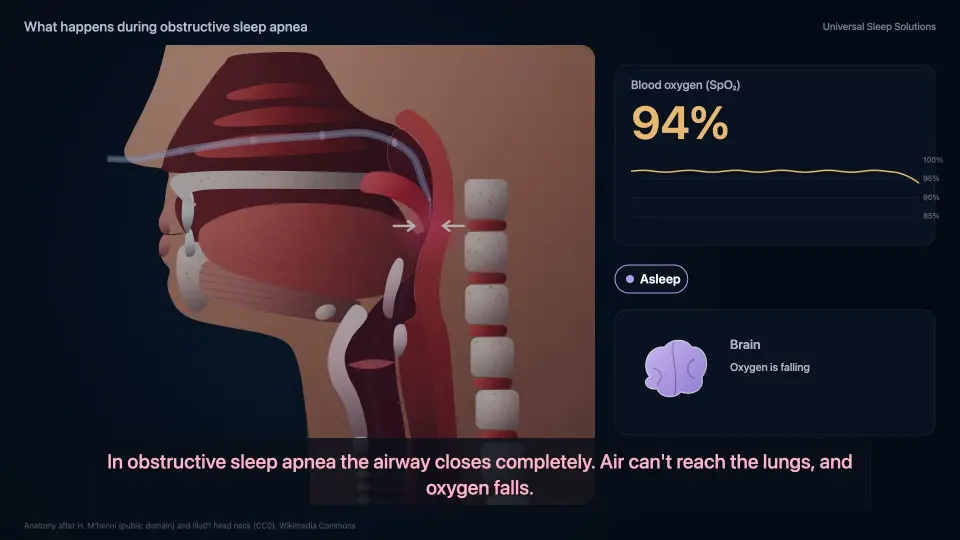
Obstructive sleep apnea (OSA) happens when the throat narrows or closes during sleep. This causes breathing pauses, drops in oxygen, and brief awakenings. Doctors measure it with the apnea-hypopnea index (AHI). This is the number of pauses and shallow breaths per hour of sleep. Sleep apnea is linked to a higher risk of AF.1
The usual treatment is CPAP (continuous positive airway pressure). This is a bedside machine that gently blows air through a mask to keep the airway open. Sleep apnea and AF so often go together. So researchers have asked whether CPAP can help keep the heart in normal rhythm.
Does CPAP help keep AF from coming back after ablation?
Several pooled analyses say it may. A 2018 review combined seven cohort studies (studies that follow groups of people over time) and three randomized trials. In all, it included 1,217 people who had an ablation.
Over about 16 months, AF came back in 24.9% of people using CPAP. It came back in 42.5% of those not using it. That is about 25% versus about 42%. People using CPAP also had a smaller upper heart chamber and stronger pumping on average.2
A 2025 review of 11 studies with 1,536 patients found similar results. The odds of AF returning were lower with CPAP. This held in studies that followed people for 18 months or longer. It also held in studies with more persistent (long-lasting) AF.1
What did the randomized trial find?
Most of the studies above were observational. They watched patients rather than testing a treatment.1,3 They compare people who chose to use CPAP with people who did not. Those groups may differ in many ways, such as overall health habits.
So the results can make the benefit look bigger than it is. A randomized trial, where chance decides who gets the treatment, gives a fairer test.
A trial from Norway included 83 people with on-and-off (paroxysmal) AF and at least moderate sleep apnea. All of them had ablation. They were randomly assigned to CPAP or usual care. Each person had a small heart monitor placed under the skin to catch every episode.
CPAP brought the AHI down from about 27 to under 2 events per hour. Yet 57% of people in both groups had at least one AF episode 3 to 12 months after ablation. The ablation itself greatly reduced AF in both groups. CPAP added no extra benefit.3
The authors of the 2025 review noted that most of their data came from observational studies. The only randomized trial showed no difference. So the results should be read with caution.1
Should you use CPAP if you have AF and sleep apnea?
For many people, yes, but for reasons that go beyond heart rhythm. The effect of CPAP on AF itself is not yet proven. What is better known is that CPAP helps how you feel.
The large SAVE trial studied people with heart or blood vessel disease. CPAP did not prevent heart attacks or strokes. But it reduced snoring and daytime sleepiness and improved mood and quality of life.4 Better sleep and more energy are worthwhile goals on their own.
Some groups, such as people with persistent AF, may benefit more from CPAP. This still needs to be tested in randomized trials.1 Treating sleep apnea works alongside, not instead of, your AF medicines and procedures. Talk with your cardiologist (heart doctor) and sleep doctor about what makes sense for you.
How does Universal Sleep Solutions help?
At Universal Sleep Solutions we offer in-lab and home sleep testing to check for sleep apnea. We set up CPAP and follow up to help you use therapy comfortably.
When CPAP is not a good fit, we look at other options. These include an oral appliance referral (a device worn in the mouth) or Inspire therapy. We are happy to work with your heart rhythm team.
When should you get checked for sleep apnea?
Think about a sleep checkup if you have AF and any of these:
- Breathing signs — Loud snoring, gasping, or pauses in breathing that others notice.
- Daytime signs — Daytime sleepiness, morning headaches, or trouble focusing.
- Blood pressure — High blood pressure that is hard to control.
- Ablation plans — You are planning an ablation, or your AF has come back after one.
- Never tested — You have been told you might have sleep apnea but were never tested.
HEART · THE EVIDENCE
Why the studies disagree
| Observational studies | Randomized trial | |
|---|---|---|
| How it workedDeciding factor | Watched people who chose CPAP or not | Chance decided who got CPAP |
| Size | 1,217 people (2018 review); 1,536 (2025 review) | 83 people with on-and-off AF |
| Tracking AF | Varied by study | Small heart monitor under the skin |
| Result | AF came back less often with CPAP | 57% had AF return in both groups |
| How to read it | Groups may differ, so benefit may look bigger | A fairer test; CPAP added no extra benefit |
The effect of CPAP on AF itself is not yet proven.
Watch and learn
References
- Efficacy of continuous positive airway pressure on atrial fibrillation recurrence after catheter ablation in patients with obstructive sleep apnea: a systematic review and meta-analysis. Journal of interventional cardiac electrophysiology : an international journal of arrhythmias and pacing, 2025. PMID 40506608 · doi:10.1007/s10840-025-02063-2
- Treating obstructive sleep apnea with continuous positive airway pressure reduces risk of recurrent atrial fibrillation after catheter ablation: a meta-analysis. Sleep medicine, 2018. PMID 29773211 · doi:10.1016/j.sleep.2018.02.013
- Effect of continuous positive airway pressure therapy on recurrence of atrial fibrillation after pulmonary vein isolation in patients with obstructive sleep apnea: A randomized controlled trial. Heart rhythm, 2022. PMID 35716856 · doi:10.1016/j.hrthm.2022.06.016
- CPAP for Prevention of Cardiovascular Events in Obstructive Sleep Apnea. The New England journal of medicine, 2016. PMID 27571048 · doi:10.1056/NEJMoa1606599
Common questions
Can sleep apnea cause atrial fibrillation?
Does CPAP stop AF from coming back after ablation?
Is CPAP still worth using with AF?
Should you get a sleep study before an AF ablation?
Trusted medical sources
This page follows guidance and research from leading medical organizations.
Further reading
- AHASleep Apnea and Heart Disease
- NHLBISleep Apnea & Cardiovascular Risk
- AASMObstructive Sleep Apnea
- NHLBISleep Apnea Information
- Mayo ClinicOSA Overview
- NIHSleep Apnea