
Research summary · strong evidence · 4 min read
Hard-to-Control Blood Pressure? Sleep Apnea May Be the Missing Piece
Why sleep apnea is so common in people with resistant hypertension, and what treating it can do for blood pressure.
General information, not medical advice. Read our disclaimer.
HEART · BLOOD PRESSURE
Hard-to-control blood pressure at a glance
- 70%+Have obstructive sleep apnea
- ~6 / 4points24-hour drop with CPAP
- Resistant means blood pressure stays high on three or more medicines.
- Each extra hour of CPAP per night was linked to bigger drops.
- Never stop or change a blood-pressure medicine on your own.
Ask about a sleep study if your blood pressure stays high and you have…
- Loud snoring, gasping or pauses in breathing during sleep
- Daytime sleepiness or trouble staying alert
- Morning headaches or a dry mouth
- High readings at night or early morning
- Waking often at night to urinate
If your blood pressure stays high even though you take three or more medicines, sleep apnea may be part of the reason. More than 70% of people with this kind of hard-to-control blood pressure have obstructive sleep apnea.1 Treating it with CPAP lowers blood pressure by a modest but real amount, and the benefit is larger in people who use CPAP more hours each night.1,2,3
What is resistant hypertension, and how is sleep apnea linked?
Hypertension means high blood pressure. It is called resistant hypertension when blood pressure stays above goal even though a person takes several blood-pressure medicines, usually three or more. In one major trial, people with resistant hypertension were taking almost four medicines on average.1 Sleep apnea is linked to higher blood pressure, which can raise the risk of heart and blood vessel problems.3
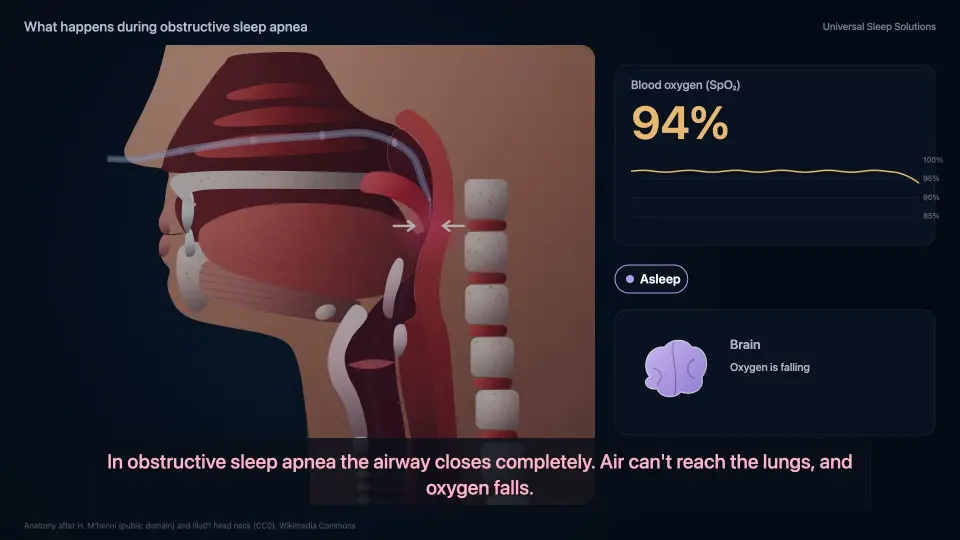
Obstructive sleep apnea (OSA) happens when the throat narrows or closes during sleep. Breathing pauses, oxygen drops, and the brain briefly wakes you to breathe again. Doctors measure sleep apnea with the apnea-hypopnea index (AHI), the number of breathing pauses and shallow breaths per hour of sleep.
Sleep apnea is very common in people with hard-to-control blood pressure. More than 70% of people with resistant hypertension have OSA.1
Does CPAP lower blood pressure?
Yes, modestly. CPAP (continuous positive airway pressure) is a bedside machine that gently blows air through a mask to hold the airway open during sleep.
- The HIPARCO trial — This trial ran in 24 hospitals in Spain. It randomly assigned 194 people with resistant hypertension and at least moderate sleep apnea to CPAP or no CPAP for 12 weeks. Everyone kept taking their usual blood-pressure medicines. Compared with the control group, the CPAP group had a greater fall in 24-hour average blood pressure (about 3 points) and in the bottom number (about 3 points). The drop in the top number was similar in size but was not statistically clear.1
- A 2024 review — It combined 12 trials with 718 people who had resistant hypertension and sleep apnea. CPAP lowered 24-hour blood pressure by about 6 points for the top number and 4 points for the bottom number. Blood pressure improved during the day and at night. The benefit was seen in both shorter and longer studies.2
What is the nighttime blood pressure dip?
Blood pressure normally falls during sleep. Doctors call it a "dipper" pattern when average nighttime blood pressure is at least 10% lower than daytime. In HIPARCO, only about a quarter of people had this pattern at the start. After 12 weeks, 36% of the CPAP group were dippers compared with 22% of the control group, so CPAP helped restore the normal drop at night.1
Does it matter how many hours you use CPAP?
It appears to. In HIPARCO, more hours of CPAP use were linked to bigger drops in blood pressure.1 A large review of 51 studies found that each extra hour of CPAP use per night was linked to a further drop of about 1.5 points in the top number and about 1 point in the bottom number.3
Using CPAP for the whole night, every night, is the goal.
Is an oral appliance an option?
For some people, yes. A mandibular advancement device is a custom mouthguard-like appliance. It holds the lower jaw slightly forward during sleep to keep the airway open.
In the same review of 51 studies, CPAP lowered blood pressure by about 2.5 points (top number) and oral appliances by about 2 points. The difference between them was not significant.3 An oral appliance may be a good choice if you can't use CPAP comfortably. Your sleep doctor can help decide whether it fits your type and severity of sleep apnea.
Can CPAP replace blood-pressure medicines?
Do not stop or change any medicine on your own. In the trials, CPAP was added on top of usual blood-pressure medicines.1
Treating sleep apnea works alongside your medicines, healthy eating, activity, and other care. Your doctor may adjust your medicines over time based on your readings.
When should you get evaluated?
Ask about a sleep study if your blood pressure stays high despite several medicines, especially if you also have:
- Breathing problems in sleep — Loud snoring, gasping, or pauses in breathing during sleep.
- Daytime sleepiness — Or trouble staying alert.
- Morning symptoms — Waking up with headaches or a dry mouth.
- High night readings — High blood pressure readings at night or in the early morning.
- Night bathroom trips — Waking often at night to urinate.
At Universal Sleep Solutions we offer in-lab and home sleep testing, CPAP setup with ongoing follow-up to help you use it comfortably, referral for an oral appliance, and evaluation for Inspire therapy for people who cannot use CPAP. We can share results with your primary care doctor or cardiologist.
HEART · BLOOD PRESSURE
CPAP vs oral appliance for blood pressure
| CPAP | Oral appliance | |
|---|---|---|
| What it is | Machine blows air through a mask | Custom mouthpiece holds jaw forward |
| Top number drop (51 studies) | About 2.5 points | About 2 points |
| Difference between them | Not significant | Not significant |
| Good choice whenDeciding factor | Most people | You cannot tolerate CPAP |
Your sleep doctor can help decide what fits your sleep apnea.
Watch and learn
References
- Effect of CPAP on blood pressure in patients with obstructive sleep apnea and resistant hypertension: the HIPARCO randomized clinical trial. JAMA, 2013. PMID 24327037 · doi:10.1001/jama.2013.281250
- Effect of Continuous Positive Airway Pressure on Blood Pressure in Patients with Resistant Hypertension and Obstructive Sleep Apnea: An Updated Meta-analysis. Current hypertension reports, 2024. PMID 38460066 · doi:10.1007/s11906-024-01294-4
- CPAP vs Mandibular Advancement Devices and Blood Pressure in Patients With Obstructive Sleep Apnea: A Systematic Review and Meta-analysis. JAMA, 2015. PMID 26624827 · doi:10.1001/jama.2015.16303
Common questions
Can sleep apnea cause high blood pressure?
How much does CPAP lower blood pressure?
Does an oral appliance lower blood pressure too?
Will you still need blood-pressure medicine?
Trusted medical sources
This page follows guidance and research from leading medical organizations.
Further reading
- AHASleep Apnea and Heart Disease
- NHLBISleep Apnea & Cardiovascular Risk
- AASMObstructive Sleep Apnea
- NHLBISleep Apnea Information
- Mayo ClinicOSA Overview
- NIHSleep Apnea