
Research summary · moderate evidence · 5 min read
Heart Failure and LVADs: Why Treating Sleep Apnea Still Matters
What the research shows about CPAP and BiPAP for people with heart failure, including those living with an LVAD heart pump.
General information, not medical advice. Read our disclaimer.
HEART · HEART FAILURE
Heart failure, LVADs and sleep apnea at a glance
- Nearly halfOf heart failure patients have OSA
- 4–5pointsPumping strength gain with CPAP
- Treating sleep apnea may help your heart, even with an LVAD.
- LVAD patients who used CPAP or BiPAP regularly lived longer in one early study.
- That study is not yet peer reviewed.
- Treatment works alongside your heart medicines, not instead of them.
Ask about a sleep evaluation if you have heart failure or an LVAD and…
- You snore loudly, or someone has seen you stop breathing
- You wake up short of breath or need to sleep propped up
- You feel worn out during the day after a full night
- You have atrial fibrillation or other rhythm problems
- You have or may get an LVAD and never had a sleep study
Yes. Sleep apnea is common in heart failure, and treating it may help your heart, even if you have a heart pump called an LVAD. When researchers pooled randomized trials, CPAP improved how strongly the heart pumps by a few points in people with heart failure and sleep apnea.3,4 One early study of LVAD recipients found that people who used CPAP or BiPAP consistently lived longer than people who did not, but that study has not yet been peer reviewed (checked by outside experts).1
What is sleep apnea, and why does it matter in heart failure?
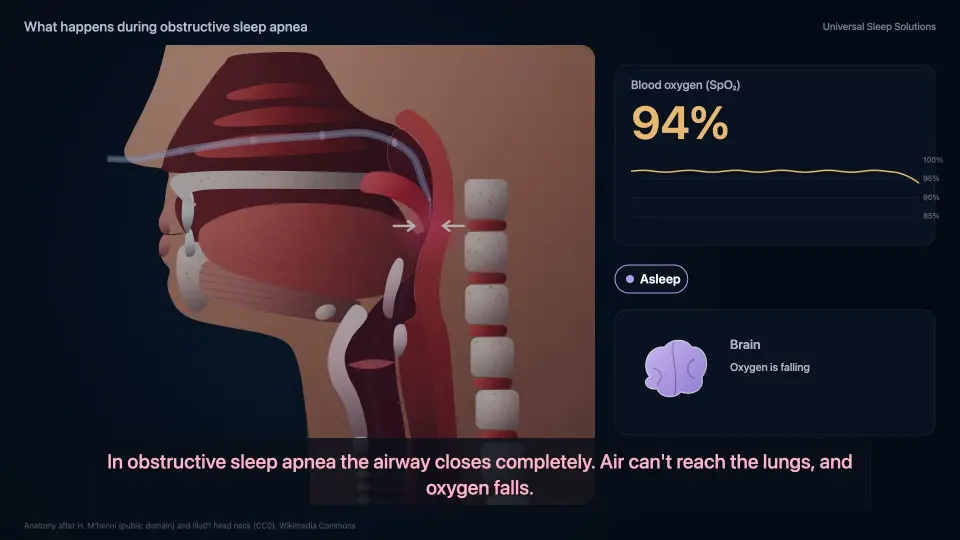
Obstructive sleep apnea (OSA) happens when the throat narrows or closes during sleep. Breathing pauses or becomes shallow, oxygen levels drop, and the brain wakes you briefly to start breathing again. Sleep doctors measure it with the apnea-hypopnea index (AHI), which is the number of pauses and shallow breaths per hour of sleep.
Heart failure means the heart cannot pump as well as the body needs. Obstructive sleep apnea is found in nearly half of people with heart failure.2
Some people with heart failure also have central sleep apnea, where the brain briefly stops sending the signal to breathe. The two types are treated differently, which is one reason a proper sleep study matters.5
What is an LVAD?
A left ventricular assist device (LVAD) is a pump placed inside the chest to help the heart's main pumping chamber move blood. It is used for advanced heart failure that has not improved enough with medicines and other devices.2
A national study looked at 22,450 hospital stays after LVAD surgery in 2020. About 9% of these patients had a diagnosis of sleep apnea on record. Their risk of dying in the hospital was similar to other patients. But they had atrial fibrillation, an irregular heart rhythm, more often (37% versus 26%).2
Does CPAP help heart failure?
CPAP (continuous positive airway pressure) is a small bedside machine that gently blows air through a mask to keep the throat open during sleep. BiPAP is a similar machine that uses one pressure when you breathe in and a lower pressure when you breathe out.
Doctors often track heart failure with the ejection fraction (EF), the share of blood the heart pushes out with each beat. Two reviews looked at it:
- 2013 review — Across 10 randomized trials, CPAP raised EF in people with sleep apnea. The gain was about 5 points in those who also had heart failure. The small change in people without heart failure was not statistically clear.3
- 2026 review — Across 10 randomized trials in heart failure with reduced ejection fraction, CPAP raised EF by about 3.7 points on average. Fixed-pressure CPAP improved EF, while auto-adjusting CPAP did not show a clear effect. The authors say this difference needs more study.4
These studies measured heart function, not survival. Sleep apnea treatment works alongside your heart medicines and devices, not instead of them.
Does CPAP or BiPAP help people with an LVAD live longer?
A single-center study looked back at patients who received an LVAD between 2007 and 2022. Overall survival was similar whether or not people had sleep apnea, and sleep apnea was not linked to more complications after surgery. But among people with sleep apnea, those who used CPAP or BiPAP consistently had significantly better survival than those who did not.1
This result is encouraging, but it needs careful reading:
- It is a preprint — It has not yet been checked by outside experts through peer review.
- It is a look-back study — It looked back at records from one hospital.
- Users may differ — People who use their machines faithfully may differ in other ways from people who do not.
The authors themselves call for larger studies across many centers.1
Is CPAP the only treatment for sleep apnea in heart failure?
No. A 2025 network review compared several treatments in heart failure, including CPAP, bilevel machines, other breathing support, and oxygen.
- Obstructive sleep apnea — CPAP improved average oxygen levels and EF, and lowered the AHI by about 20 events per hour.
- Central sleep apnea — Results varied by treatment and by which outcome was measured.
The authors concluded that no single treatment helps every measure.5 That is why device choice in heart failure should be made together by your sleep and heart teams.
When should you get evaluated?
Ask about a sleep evaluation if you have heart failure or an LVAD and any of the following:
- Snoring or gasping — Loud snoring, or someone has seen you stop breathing or gasp in your sleep.
- Night breathlessness — Waking up short of breath, or needing to sleep propped up.
- Daytime sleepiness — Feeling sleepy or worn out during the day even after a full night in bed.
- Rhythm problems — Atrial fibrillation or other rhythm problems.
- LVAD without a sleep study — You are being evaluated for an LVAD, or you already have one and have never had a sleep study.
At Universal Sleep Solutions we offer in-lab sleep studies and home sleep testing to find out whether you have sleep apnea and which type. If treatment is needed, we set up CPAP or BiPAP and follow up to review how well therapy is working.
If you already have a machine but struggle to use it, let us know. Consistent use appears to be where the benefit lies.
HEART · DEVICES
CPAP vs BiPAP
| CPAP | BiPAP | |
|---|---|---|
| Air pressureDeciding factor | One steady pressure all night | Higher breathing in, lower breathing out |
| How it feels | Steady airflow through a mask | Some people find it easier |
| Use with an LVAD | Yes | Yes |
In heart failure, your sleep and heart teams choose the device together.
Watch and learn
References
- CPAP/BiPAP Compliance Improves Survival in LVAD Recipients with Obstructive Sleep Apnea. medRxiv : the preprint server for health sciences, 2026. PMID 42078378 · doi:10.64898/2026.04.20.26351345 (preprint, not peer reviewed)
- The association of obstructive sleep apnea and complications in patients following implantation of left ventricular assist devices. Respiratory medicine, 2025. PMID 40550288 · doi:10.1016/j.rmed.2025.108218
- Impact of continuous positive airway pressure treatment on left ventricular ejection fraction in patients with obstructive sleep apnea: a meta-analysis of randomized controlled trials. PloS one, 2013. PMID 23650511 · doi:10.1371/journal.pone.0062298
- Continuous positive airway pressure on left ventricular ejection fraction in obstructive sleep apnea and heart failure with reduced ejection fraction: a systematic review and meta-analysis. Sleep and biological rhythms, 2026. PMID 41551897 · doi:10.1007/s41105-025-00604-w
- Comparative effectiveness of therapies for sleep-disordered breathing in heart failure patients: A comprehensive systematic review and network meta-analysis. Respiratory medicine, 2025. PMID 39645004 · doi:10.1016/j.rmed.2024.107907
Common questions
Is sleep apnea common in heart failure?
Can people with an LVAD use CPAP?
Will CPAP fix my heart failure?
What is the difference between CPAP and BiPAP?
Trusted medical sources
This page follows guidance and research from leading medical organizations.
Further reading
- AHASleep Apnea and Heart Disease
- NHLBISleep Apnea & Cardiovascular Risk
- AASMObstructive Sleep Apnea
- NHLBISleep Apnea Information
- Mayo ClinicOSA Overview
- NIHSleep Apnea