
Guide · 2 min read
CPAP Therapy – The Gold Standard for Sleep Apnea Treatment
Expert help with CPAP therapy, mask fitting and fixing common problems so your treatment works.
General information, not medical advice. Read our disclaimer.
CPAP · THE BASICS
CPAP at a glance
- CPAP is the most effective and most used sleep apnea treatment.
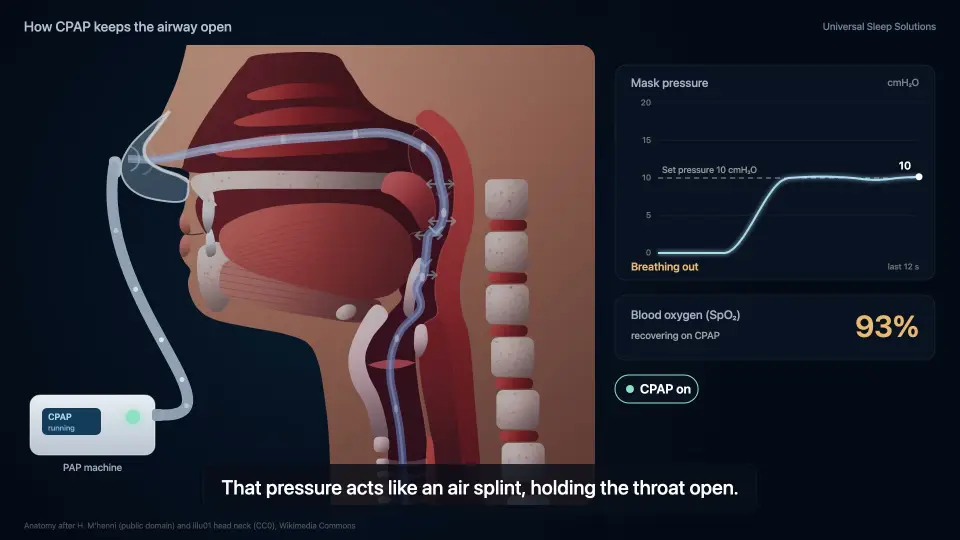
- Air through a mask works like a splint for your airway.
- It can stop snoring and ease daytime sleepiness.
- It lowers blood pressure and heart disease risk.
- If you cannot use CPAP, there are other options.
CPAP (Continuous Positive Airway Pressure) is the most effective and most used treatment for obstructive sleep apnea. In this kind of sleep apnea, your airway gets blocked again and again while you sleep. CPAP sends a steady flow of air through a mask. This keeps your airway open while you sleep.
How does CPAP work?
A CPAP machine pushes air through a mask. The mask goes over your nose, your mouth, or both. The air pressure works like a splint made of air. It holds your airway open so it does not collapse while you sleep.
How does CPAP help?
- Stops snoring — It stops snoring and pauses in breathing.
- Helps you sleep better — You sleep better and feel less sleepy during the day.
- Lowers blood pressure — It also lowers the risk of heart and blood vessel disease.
- Helps your mind — It helps your mood, focus and memory.
- Lowers your risk of crashes — Fewer crashes from driving while drowsy.
What types of PAP machines are there?
- CPAP — Gives one steady pressure all night.
- Auto-CPAP (APAP) — Changes the pressure on its own as needed.
- BiPAP — Gives one pressure when you breathe in and a different one when you breathe out.
What if you can't use CPAP?
If you cannot use CPAP, other options include:
- Oral appliance — A custom mouthpiece from a dentist that changes the position of your jaw.
- Weight loss — This can make sleep apnea much milder.
- Positional therapy — This helps if your apnea happens mostly in certain sleep positions.
- Surgery — This can help when the cause is the shape of your airway.
Call (512) 931-1575 to talk with Dr. Patel about CPAP or other options.
CPAP · MACHINE TYPES
Types of PAP machines
| How the pressure works | |
|---|---|
| CPAP | One steady pressure all night |
| Auto-CPAP (APAP) | Changes the pressure on its own as needed |
| BiPAP | One pressure when you breathe in, another when you breathe out |
Watch and learn
Common questions
How long does it take to get used to CPAP?
What if I can't use CPAP?
Trusted medical sources
This page follows guidance and research from leading medical organizations.
Further reading
- AASMCPAP Therapy
- Sleep FoundationCPAP Machines
- NHLBIPAP Therapy Overview
- AASMObstructive Sleep Apnea
- NHLBISleep Apnea Information
- Mayo ClinicOSA Overview
Part of our sleep apnea management service.