
Guide · 2 min read
Sleep Apnea Symptoms – Recognize the Warning Signs
Millions of Americans have undiagnosed sleep apnea. Learn the signs so you can get the treatment you need.
General information, not medical advice. Read our disclaimer.
SLEEP APNEA · SYMPTOMS
Sleep apnea symptoms at a glance
- 25–30%Of men affected
- 10–15%Of women affected
- Up to 80%Of cases undiagnosed
- Loud, chronic snoring is the most common sign.
- Obesity is the strongest risk factor.
- Other risks: male sex, age over 40, large neck, family history.
- Untreated sleep apnea raises heart disease and stroke risk.
- A sleep study is the only definitive way to diagnose it.
See a sleep doctor if you have…
- Loud snoring with gasping, choking or breathing pauses
- Heavy daytime sleepiness
- Morning headaches or a dry mouth on waking
- Trouble focusing, memory problems or mood changes
- Restless sleep or waking often to pee
Obstructive sleep apnea (OSA) is estimated to affect 25-30% of men and 10-15% of women. Yet up to 80% of cases remain undiagnosed. Knowing the symptoms is the first step toward getting help from a sleep apnea specialist.
What are the nighttime symptoms?
- Loud, long-term snoring — Snoring that happens night after night.
- Breathing pauses — Pauses (apneas) that someone else sees.
- Gasping, choking, or snorting — These happen during sleep.
- Restless sleep — Waking up often.
- Nocturia — Peeing often at night.
- Night sweats — Sweating during sleep.
What are the daytime symptoms?
- Daytime sleepiness — Feeling too sleepy during the day.
- Morning headaches — Headaches when you wake up.
- Trouble focusing — Trouble concentrating and memory problems.
- Mood changes — Feeling cranky and other mood changes.
- Lower sex drive — Less interest in sex (decreased libido).
- Dry mouth or sore throat — When you wake up.
Who is at higher risk?
- Obesity — The strongest risk factor.
- Male sex — Though women are also affected.
- Age over 40 — Risk is higher after age 40.
- Large neck size — More than 17 inches for men or 16 inches for women.
- Family history — Family members with sleep apnea.
- Body shape — Large tonsils or a chin that sits far back.
What happens if sleep apnea isn't treated?
Without treatment, sleep apnea raises the risk of:
- Heart problems — Heart disease and stroke.
- High blood pressure — Also called hypertension.
- Type 2 diabetes — A long-term illness with high blood sugar.
- Depression — Long-lasting low mood.
- Car crashes — Motor vehicle accidents.
If you notice these symptoms, call (512) 931-1575 to schedule an evaluation.
SLEEP APNEA · SYMPTOMS
Night and day signs
| What you may notice | |
|---|---|
| Breathing at nightDeciding factor | Loud snoring, breathing pauses, gasping or choking |
| Sleep at night | Restless sleep, waking often, night sweats, peeing often |
| On waking | Morning headache, dry mouth or sore throat |
| During the day | Heavy sleepiness, trouble focusing, memory problems |
| Mood | Irritability, mood changes, lower sex drive |
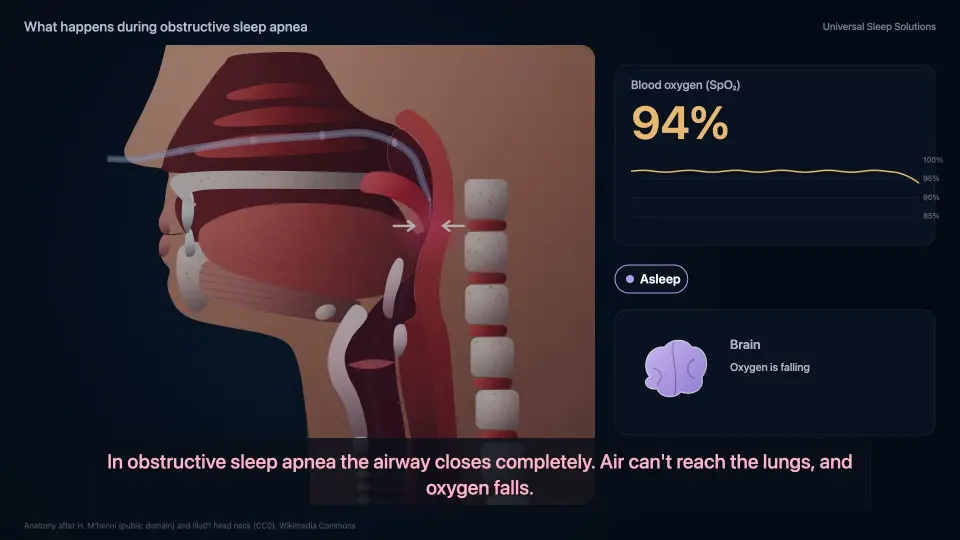
Watch and learn
Common questions
Can you have sleep apnea without snoring?
Yes. Snoring is the most common symptom, but some patients — especially women — may have sleep apnea without much snoring. Other symptoms like tiredness, insomnia (trouble sleeping), and morning headaches may be the main complaints.
How do I know if I have sleep apnea?
A sleep study is the only sure way to diagnose sleep apnea. If you have risk factors or symptoms, see a sleep specialist for an evaluation.
Trusted medical sources
This page follows guidance and research from leading medical organizations.
Further reading
- AASMObstructive Sleep Apnea
- NHLBISleep Apnea Information
- Mayo ClinicOSA Overview
- NIHSleep Apnea
- AASMObstructive Sleep Apnea
- NHLBISleep Apnea Treatment
Part of our sleep apnea management service.